
Introduction
In last week’s message, Moses returned to instructions regarding the celebration of the Passover and the Feast of Unleavened Bread (FoUB). This time, however, he did not focus on the when but on the who. Given that emphasis, I thought it would be helpful to take this opportunity to make a case for paedocommunion from this text.
For the uninitiated, paedocommunion is the belief that baptized covenant children should partake of the Lord’s Supper. In a previous post, we examined the history of the doctrine, which can be found here:
https://holycovenantchurch.com/history-of-paedocommunion/
As we consider this topic, it is important to state one major assumption at the outset: Passover is the forerunner of the Lord’s Supper. We know this because the Lord’s Supper was instituted on the night of Passover. What we see is Jesus reinterpreting the shadow (Passover) in light of Himself and His saving work on behalf of His people.
With that assumption in place, we can now make a case for paedocommunion from Exodus 12.
Passover as a Meal
One of the things that often gets lost when discussing Passover and the FoUB is that both were meals. We rightly focus on the sacrificial and atoning aspects, but we must not miss that, in addition to being sacrificial, they included real, covenantal meals.
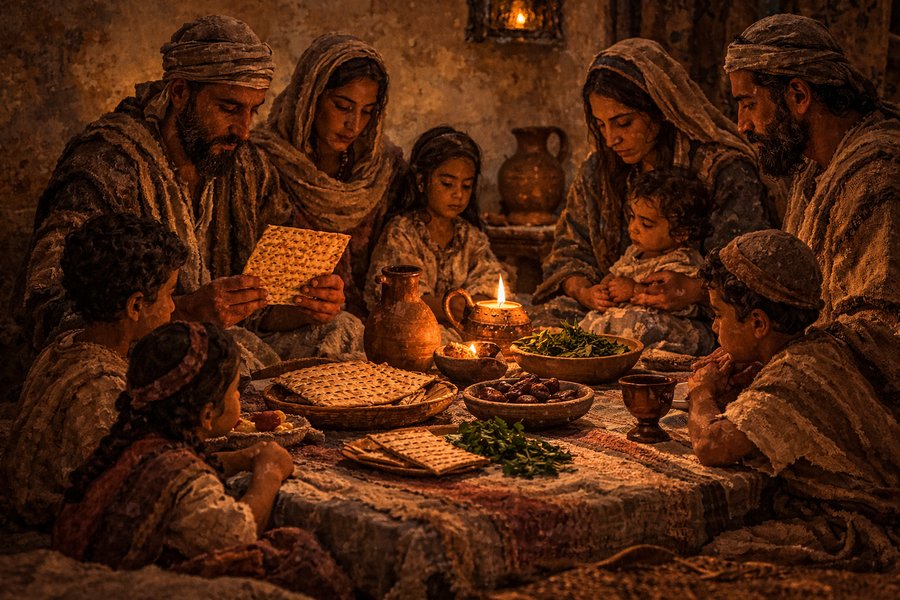
As you read through the instructions, this is clearly seen in the command that the people were to eat the meat as households (Ex. 12:46). It seems obvious that the children partook of the meal. If not, when would they have eaten? In fact, they play an important role in the celebration—a point we will return to later.
When we shift to the New Testament and examine the Lord’s Supper, we see something similar. Some of this is lost on us because of how we celebrate it today. Many churches partake of a small piece of bread and a thimble of wine, but Scripture and history paint a fuller picture.
Consider how Paul rebukes the Corinthians in 1 Corinthians 11:20–22. Some were eating private suppers while others went hungry, and some were even getting drunk. This suggests that the Supper functioned within the context of a real meal. Would it be likely that the children were excluded from such meals? If they were excluded, when did they eat? History (as noted in the previous article) indicates that baptized children did partake of the Lord’s Supper in the early church, just as children participated in the Passover meal.
Prerequisite for the Meal
The question of who qualifies to participate in Passover and the FoUB is also addressed in our text. Moses writes:
“No foreigner may eat of it. Any slave you have bought may eat of it after you have circumcised him…
A foreigner residing among you who wants to celebrate the Lord’s Passover must have all the males in his household circumcised; then he may take part like one born in the land. No uncircumcised male may eat of it.”
The qualification is clear: those who were circumcised could participate. This would have included children who had received the covenant sign.
When we transition to the New Covenant and consider the prerequisite for participating in the Lord’s Supper, we do not find an equally explicit command as in Exodus 12. However, the case can be made implicitly. If we ask what covenant sign marks entry into the community of believers, the answer is baptism.
Consider how closely Scripture connects baptism with union with Christ. Paul writes in Romans 6:3–4:
“Or don’t you know that all of us who were baptized into Christ Jesus were baptized into His death? We were therefore buried with Him through baptism into death in order that, just as Christ was raised from the dead through the glory of the Father, we too may live a new life.”
Neither circumcision nor baptism automatically grants salvation. Both point to deeper heart realities (Deut. 30:6). Yet both function as covenant signs of inclusion and allow participation in the community and its sacred meals.
A Teaching Meal
One critique of paedocommunion centers on a child’s inability to profess faith and appeals to Paul’s words in 1 Corinthians 11 that participants must “discern the body.” Advocates of credocommunion exclude children on this basis. How should we respond?
First, consider the logic of Passover and how it applies to the Lord’s Supper. Built into the Passover celebration was the inclusion of children and the nurturing of their faith. Moses writes:
“And it shall be, when your children say to you, ‘What do you mean by this service?’ that you shall say, ‘It is the Passover sacrifice of the Lord, who passed over the houses of the children of Israel in Egypt when He struck the Egyptians and delivered our households.’”
The meal itself prompted questions and provided opportunity for instruction. God’s design was not to exclude children until they had mastered understanding, but to include them as a means of cultivating faith.
The same logic can—and I would argue should—apply to the Lord’s Supper. If children receive the covenant sign and partake of the sacred meal (as they historically did), parents are given a powerful teaching tool to nurture their faith in Christ, just as Israelite parents did during Passover and the FoUB.
Second, how should we understand Paul’s command to “discern the body”? In context, several things are clear:
- Paul is primarily addressing adults who were undermining the gospel by excluding others and abusing the meal.
- His admonition is not chiefly about articulating a full systematic theology, but about recognizing the sacred nature of the meal and the unity of Christ’s body.
- In light of this, children are capable—at an age-appropriate level—of recognizing that they belong to God’s covenant community and growing into a deeper understanding over time.
Conclusion
In the end, much more could be said. At a minimum, however, I believe that the pattern established in the Passover, the covenantal logic connecting circumcision and baptism, the historical practice of the early church, and the teaching function of the meal together form a cumulative case. God’s covenant meals have always been communal, covenantal, and formative. If baptized children belong to the covenant community, there is strong biblical and theological reason to welcome them to the covenant table.
Related sermon link: https://www.youtube.com/watch?v=VWCXDINnlzo