
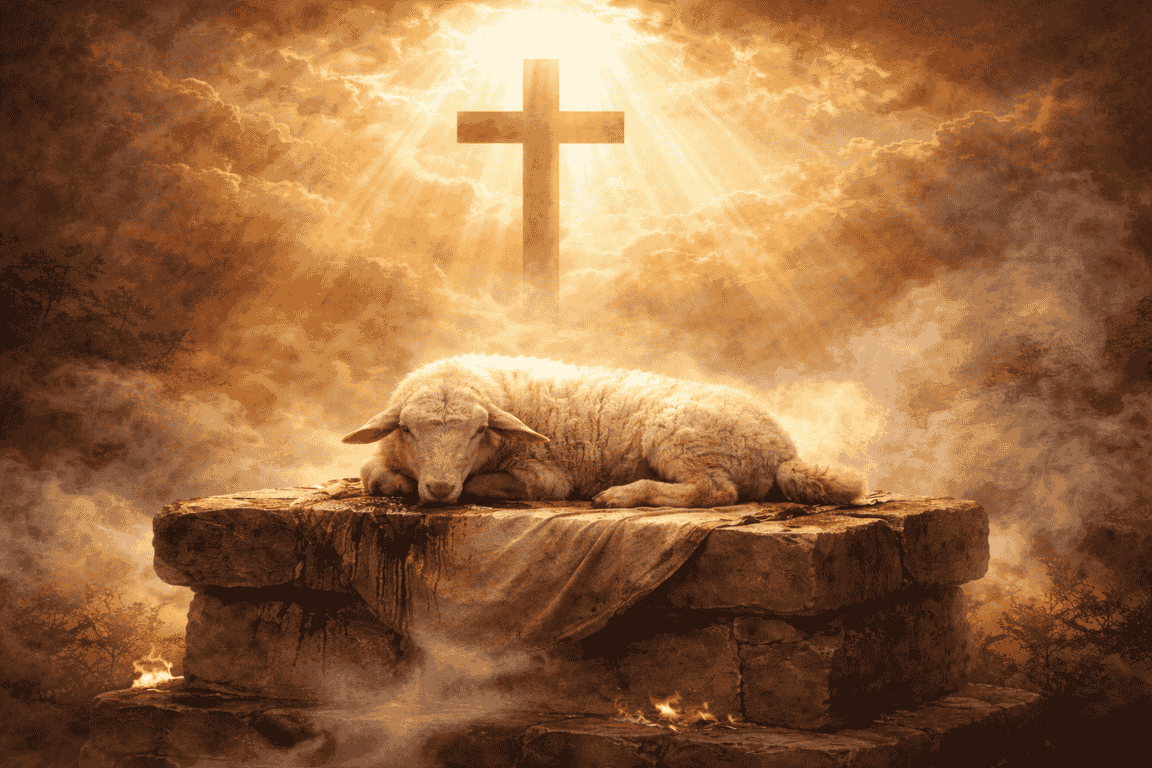
Introduction
In 1 John 2:2, John writes:
“And He Himself is the propitiation for our sins, and not for ours only but also for the whole world.”
This verse reveals the nature and depth of what Jesus accomplished on behalf of His people. An important word in the above cited verse is propitiation, which communicates something regarding Christ’s sacrifice. However it is not the only key word regarding Christ’s sacrifice, alongside it, is the term expiation. The latter term is only used in a few old translations (e.g. RSV and NEB).
Unlocking the full meaning of what Christ has accomplished requires an understanding of what propitiation and expiation signify. The goal of this post is to explore these terms within the broader framework of atonement, the topic recently preached on last week. The sermon from this past week can be listened to here: https://www.youtube.com/watch?v=q0El7lJpHo4
Atonement
Before addressing the two terms specifically, it is important to note that propitiation and expiation fall under the umbrella of atonement. The Hebrew noun underlying it is kopher, which is related to the verb kaphar.
This is evident in Leviticus 16, describing the Day of Atonement (Yom Kippur), perhaps the holiest day on Israel’s calendar. The verb kaphar saturates the chapter:
Leviticus 16:6 – “Aaron shall… make atonement for himself and for his house.”
Leviticus 16:10 – The live goat “shall be presented… to make atonement over it.”
Leviticus 16:11 – “He shall make atonement for himself and for his house.”
Leviticus 16:16 – “Thus he shall make atonement for the Holy Place…”
Leviticus 16:17 – “He shall make atonement for himself and for his house and for all the assembly of Israel.”
Leviticus 16:18 – “He shall go out to the altar… and make atonement for it.”
Leviticus 16:24 – “He shall offer his burnt offering… and make atonement for himself and for the people.”
Leviticus 16:27 – The carcasses are burned “whose blood was brought in to make atonement in the Holy Place.”
Leviticus 16:30 – “On this day shall atonement be made for you to cleanse you.”
Leviticus 16:32 – “The priest… shall make atonement.”
Leviticus 16:33 – “He shall make atonement for the holy sanctuary… the tent of meeting… the altar… the priests… and all the people.”
From this, we learn that to make atonement means to provide a covering through a substitute who dies on behalf of someone or something. In the Old Covenant, this substitute included lambs, goats, and oxen. Yet atonement has a couple of facets, and this is where propitiation and expiation deepen our understanding.
Propitiation
Christ provides the ultimate atonement, for He is our propitiation. The Greek word ἱλασμός (hilasmós) highlights a specific aspect — the vertical element.
- Vertical element: Jesus, as our substitute, appeases the wrath of an infinitely holy and righteous God. Scripture reminds us that God’s wrath abides on all who are outside of Christ (John 3:36).
- Paul emphasizes this in Romans 3:25–26:
“…whom God set forth as a propitiation by His blood, through faith, to demonstrate His righteousness, because in His forbearance God had passed over the sins previously committed, to demonstrate at the present time His righteousness, that He might be just and the justifier of the one who has faith in Jesus.”
Notice how God sent Jesus, in order to deal with sin, yet connects it to his holy character. Ultimately propitiation shows Christ satisfying God’s wrath, which flows from his character, so that sinners may be reconciled to Him.
Expiation
While propitiation appears in many translations, expiation is found in several older translations. It comes from the Greek word ἱλαστήριον (hilastērion), related to propitiation, but it emphasizes another dimension of Christ’s work.
- Horizontal element: Whereas propitiation addresses God’s wrath, expiation addresses the sinner’s guilt and shame, cleansing them from sin.
Leviticus 16 illustrates this, particularly verses 20 and 21. Consider how the priest laid hands on the second goat on the Day of Atonement, “transferring” the people’s sins. However, unlike the first goat, this one was not killed, but was released alive into the wilderness, symbolizing the removal of guilt and shame from the people.
Expiation demonstrates that the people of God are restored and cleansed from the fruit of sin, namely guilt and shame.
Conclusion
Both elements are essential and must be maintained. Writing about this point, Bavinck observes that the cross is not just a cleansing influence (expiation), but judicial satisfaction (propitiation). This is especially so when we compare Christ’s once and for all sacrifice to the countless animals sacrificed in the Old Testament epoch.
The result? Praise to God for Christ and a call to faithfully live out our magnificent and multidimensional redemption.