
Introduction
This last Lord’s Day we considered how the Exodus continues God’s creative work. In that moment, it was not the heavens and the earth being formed, but a people. God was creating a nation that, like the original creation, would display His glory.
Yet Exodus is not the only place where Scripture echoes Genesis 1. Throughout the biblical storyline, God brings about new beginnings through the waters.
In this post, we turn to another powerful example of that pattern: the Flood narrative.
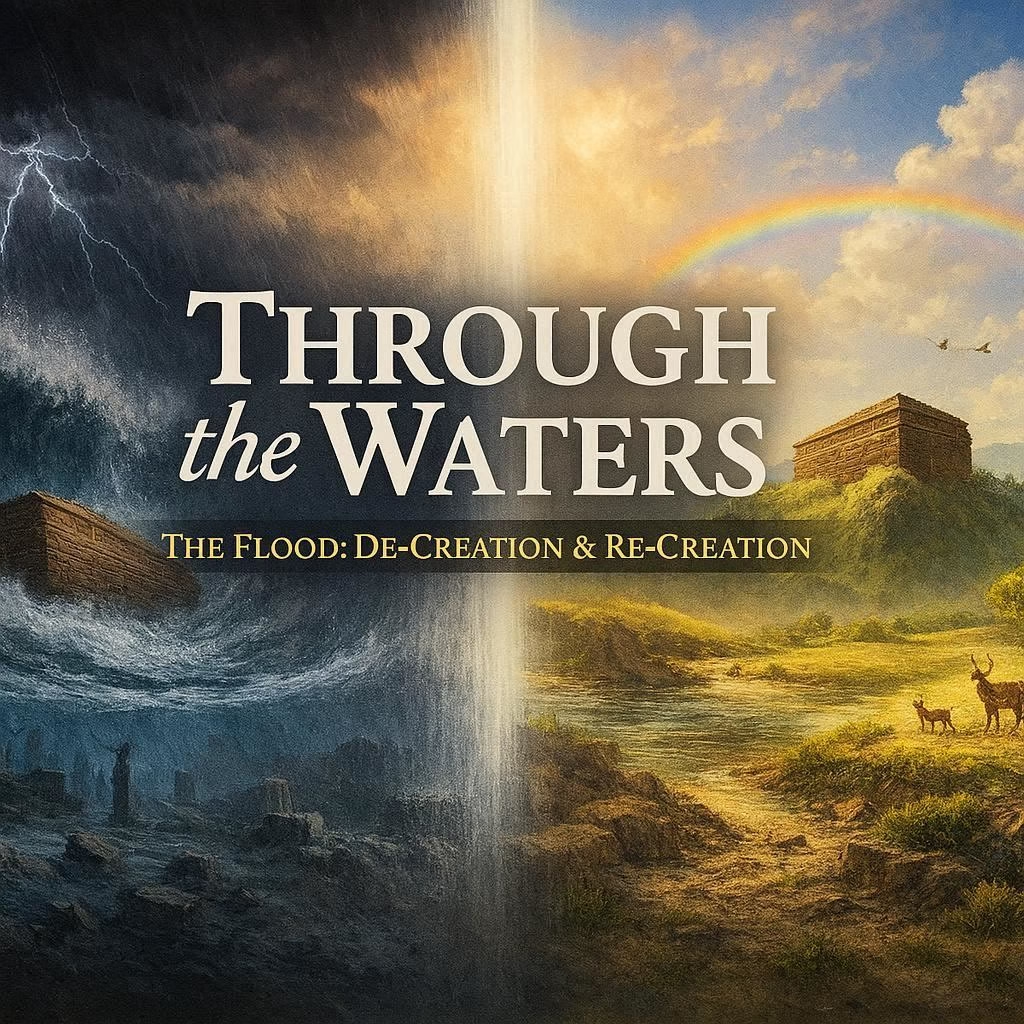
The Flood is not merely a story about rain and an ark. It is an act of de-creation—and then, by grace, re-creation. It fits a theological pattern repeated throughout redemptive history.
De-Creation: When the Boundaries Collapse
Genesis 7:11 tells us:
“All the fountains of the great deep burst forth, and the windows of the heavens were opened.”
Do you hear the echoes of Genesis 1?
In creation, God separated the waters above from the waters below. He established boundaries. He formed dry land. He imposed order upon chaos.
But in the Flood, those separated waters reunite. The structured world collapses back into the deep. Dry land disappears. The ordered cosmos returns to watery judgment.
This is not random destruction. It is moral de-creation.
Genesis 6 tells us the earth was filled with violence and corruption. Humanity had unraveled the order God established. Sin always undoes what God beautifully creates.
The Flood shows us that when rebellion reaches its fullness, judgment follows.
And yet—God’s de-creation is not a loss of control. It is a display of His holiness.
Grace Before the Storm
Before a single drop of rain falls, we read one of the most important sentences in the Old Testament:
“But Noah found favor in the eyes of the Lord.”
Grace precedes deliverance.
Noah is not introduced as a self-made savior. He is the recipient of divine favor. God provides the design of the ark. God establishes the covenant. God shuts the door.
Salvation does not originate with man climbing upward—it begins with God stooping downward.
Even in judgment, mercy is already at work.
Passing Through the Waters
For those outside the ark, the waters mean death.
For those inside, the waters become the pathway to a new world.
Notice the pattern:
- Judgment falls
- A mediator is appointed
- A remnant is preserved
- The waters recede
- Dry land appears
When the ark comes to rest and the earth begins to dry, the language intentionally echoes Genesis 1. Once again, dry ground emerges from the waters. Once again, life steps onto a cleansed earth.
The Flood is not the end of creation. It is a reset—a re-creation under covenant grace.
God blesses Noah with the same commission given to Adam:
“Be fruitful and multiply and fill the earth.”
The story has not been abandoned. It has entered another phase.
Salvation Is Re-Creation
Like the Exodus, the Flood teaches us that salvation is not merely escape from danger—it is re-creation.
Noah does not simply survive the storm. He steps into a renewed world under covenant promise. God is not merely sparing individuals; He is preserving His purposes for creation itself.
This logic carries forward throughout Scripture:
God does not merely rescue; He renews.
He does not simply deliver from; He forms anew.
Divine salvation always involves transformation. The old order of violence and corruption is judged. A cleansed beginning is granted.
Salvation at the Intersection of Judgment and Mercy
The Flood also reinforces something we observed at the Red Sea.
There was one event—one set of waters—but two radically different outcomes.
For the world: judgment.
For Noah and his family: mercy.
The same waters that destroy the wicked lift the ark.
Judgment and mercy intersect in the very same act.
This pattern echoes throughout redemptive history and ultimately points us to Christ. At the cross, judgment falls fully and finally—but for those united to Him, that judgment becomes the doorway to life.
Just as Noah passed safely through the flood because he was inside the ark, so believers pass safely through judgment because they are in Christ.
Living as People of the New Beginning
What does this mean for us?
First, we must take sin seriously. The Flood reminds us that God is patient—but not indifferent. Corruption and violence grieve Him.
Second, we must cling to grace. The only reason anyone survives the Flood is divine favor.
Third, we must live as those who have stepped onto dry ground. Noah did not exit the ark to rebuild the old corrupt order. He stepped into covenant relationship with the God who saves.
We too are called to live as people shaped by mercy—grateful, obedient, and mindful that our very existence rests upon grace.
Conclusion
The Flood is not merely an ancient catastrophe. It is a theological declaration:
- God judges sin.
- God preserves a people.
- God continues His creative purposes.
Through the waters of chaos, He brings about new beginnings.
May we never forget that the same God who once brought dry land out of the deep is the God who still brings life out of judgment and hope out of ruin.
Sermon link: https://www.youtube.com/watch?v=Ity1Y_YwX_A