
Introduction
Two Sundays ago we worked through Exodus 19 and we saw how the narrative was driving toward God gracing His people with His presence. The great blessing of the Exodus was not simply that Israel had been delivered from Pharaoh. God delivered them to bring them to Himself:
“I bore you on eagles’ wings and brought you to Myself.”
—Exodus 19:4, NKJV
Here is an important point to remember, redemption has a destination and it is always the presence of God.
Additionally what is happening in Exodus helps us see that something more than the giving of the Law is happening at Sinai. The boundaries around the mountain, the different levels of access, the altar at its foot, and God’s glory at its summit all anticipate the Tabernacle Israel will soon build. This tabernacle will be the place where Yahweh will live amongst his people.
In other words, before Israel built the Tabernacle, God brought them to a mountain that functioned like one.
But even that pattern was not new. Sinai points forward to the Tabernacle and Temple, but it also points backward to Eden. The Bible’s sanctuary story does not begin at Sinai. It begins in the Garden.
Eden: The First Sanctuary
Eden was the original earthly sanctuary, the place where God dwelt with man. God placed Adam in the garden “to tend and keep it” (Gen. 2:15). The Hebrew verbs can carry the sense of serving and guarding and later appear together in connection with the Levites and their responsibilities at the Tabernacle (Num. 3:7–8; 8:26). Adam’s calling, therefore, had a priestly character: he was to serve in God’s presence and guard what God had made holy.
Seeing Eden as a sanctuary is not a novel interpretation. Gordon Wenham explored these parallels in Sanctuary Symbolism in the Garden of Eden Story. G. K. Beale develops them extensively in The Temple and the Church’s Mission, while John Walton and others have likewise recognized Eden as sacred space and Adam’s vocation as priest-like. The details are debated, but the larger Eden-sanctuary connection has substantial precedent.
One intriguing connection is the three-fold structure of sacred space. Genesis distinguishes the wider world, Eden, and the garden associated with God’s special presence (Gen. 2:8–10). Beale and others see here the beginnings of a pattern that becomes clearer as Scripture unfolds.
At Sinai, Israel remains below, priestly representatives ascend farther, and Moses alone enters the glory of God. In the Tabernacle and Temple, we find the Outer Court, Holy Place, and Most Holy Place. We should not press every correspondence as though Genesis gives us an architectural blueprint, but the recurring movement toward increasingly holy space is significant.
The connection becomes clearer after the Fall. Adam and Eve are driven out, and God stations cherubim at the east “to guard the way to the tree of life” (Gen. 3:24). Cherubim later appear on the veil guarding the Most Holy Place (Ex. 26:31), above the mercy seat (Ex. 25:18–22), and in the inner sanctuary of Solomon’s Temple (1 Kings 6:23–29).
Adam had been called to guard God’s sanctuary, but he failed. The serpent entered, Adam rebelled, and man was driven from God’s presence.
The great problem of Scripture has emerged: God made man to dwell in His presence, but sinful man cannot casually enter the presence of a holy God.
Sinai: The Mountain Sanctuary
When God descends upon Sinai, He once again establishes sacred space:
“You shall set bounds for the people all around.”
—Exodus 19:12, NKJV
As the narrative unfolds, different levels of access emerge. Israel remains below. Aaron, Nadab, Abihu, and seventy elders ascend farther (Ex. 24:9–10). Moses alone approaches the LORD and finally enters the cloud of God’s glory (Ex. 24:2, 15–18).
The pattern resembles what will soon appear in the Tabernacle: the people in the outer court, the priests in the Holy Place, and the high priest alone entering the Most Holy Place.
Sinai takes the sanctuary pattern visible in Eden and displays it on a mountain. The Tabernacle takes the geography of Sinai and turns it into architecture.
An altar stands at the foot of Sinai where sacrifices are offered (Ex. 24:4–5). God’s glory rests above, and Moses enters the cloud. Then, immediately afterward, the LORD says:
“And let them make Me a sanctuary, that I may dwell among them.”
—Exodus 25:8, NKJV
But the story cannot end at Sinai, they must continue toward the Promised Land. So God gives them, in a sense, a Sinai that can travel with them. What is it, well the next section answers that question.
From Mountain to Tabernacle
At Sinai, “the glory of the LORD rested on Mount Sinai” (Ex. 24:16). When the Tabernacle is completed, “the cloud covered the tabernacle of meeting, and the glory of the LORD filled the tabernacle” (Ex. 40:34).
The cloud that covered the mountain now covers the Tabernacle.
Israel leaves the mountain, but the God of the mountain goes with them.
The larger story of Exodus now comes into focus. The book begins with Israel enslaved under Pharaoh and ends with God’s glory dwelling in Israel’s midst. God does not merely redeem His people from slavery. He redeems them for Himself. In a very real sense we are getting closer to the way things were in Eden.
From Tabernacle to Temple
When Israel settles in the land, the movable sanctuary eventually gives way to a permanent house. Solomon’s Temple preserves the same basic sacred geography: court, Holy Place, and Most Holy Place.
But the Temple also looks backward to Eden. Its walls are carved with cherubim, palm trees, and open flowers (1 Kings 6:29, 32, 35). Its furnishings contain lilies, pomegranates, branches, and blossoms. The lampstand itself resembles a flowering tree (Ex. 25:31–36).
The Temple is not simply a larger or fixed Tabernacle. Its garden imagery recalls the original sanctuary from which humanity had been expelled.
The Problem of Access
Yet the fundamental problem introduced in Eden remained unresolved. God had come to dwell among His people, but they still could not freely enter His presence.
At Eden, cherubim guarded the way. At Sinai, boundaries guarded the mountain. At the Tabernacle and Temple, a veil guarded the Most Holy Place.
Israel could come near—but only so near.
The people needed sacrifices because of their sin and priests to represent them before God. Even the priests could not simply enter the Most Holy Place. Only the high priest could enter, only once a year, and never without blood (Lev. 16; Heb. 9:7).
The sanctuary provided access to God while simultaneously reminding Israel that full access had not yet been opened.
Something greater was needed: a better sacrifice, a better priest, and a better mediator.
The Garden, the mountain, the Tabernacle, and the Temple all revealed God’s desire to dwell with His people. But they also pointed beyond themselves.
The sanctuary story was waiting for Christ.
Christ: The Way Into God’s Presence
When Jesus comes, these themes converge in Him.
He is the true Temple, God dwelling among His people (John 1:14; 2:19–21). He is the greater Mediator, surpassing Moses. He is the great High Priest, who enters the true heavenly sanctuary on behalf of His people. And He is the Sacrifice whose blood opens the way into God’s presence.
This is why the tearing of the Temple veil at Christ’s death is so significant:
“Then, behold, the veil of the temple was torn in two from top to bottom.”
—Matthew 27:51, NKJV
The barrier that proclaimed restricted access into God’s presence was torn as Christ offered Himself.
The movement of the biblical story can now be seen clearly:
In Eden, man is driven out. At Sinai, Israel is warned not to cross the boundary. In the Tabernacle and Temple, the veil says, “You may come only so far.” But because of Christ, Hebrews says, “Let us draw near.”
“Therefore, brethren, having boldness to enter the Holiest by the blood of Jesus…let us draw near with a true heart in full assurance of faith.”
—Hebrews 10:19, 22, NKJV
God has not become less holy. Rather, Christ has accomplished what was necessary to bring sinners into the presence of the Holy One.
The sacrifice has been offered. The greater High Priest has entered. The veil has been torn. The way has been opened.
From Eden to the New Creation
Remarkably, the Bible ends where it began—with God dwelling with man:
“Behold, the tabernacle of God is with men, and He will dwell with them.”
—Revelation 21:3, NKJV
Yet something has changed:
“But I saw no temple in it, for the Lord God Almighty and the Lamb are its temple.”
—Revelation 21:22, NKJV
There is no longer a temple separating sacred space from common space. God’s presence fills everything. The tree of life appears again, the curse is gone, and God’s throne is among His people (Rev. 22:1–3).
The Bible begins with humanity expelled from a garden sanctuary and ends with redeemed humanity dwelling with God in a garden-city.
What was lost in Eden is restored and surpassed in Christ. The flow looks like as follows:
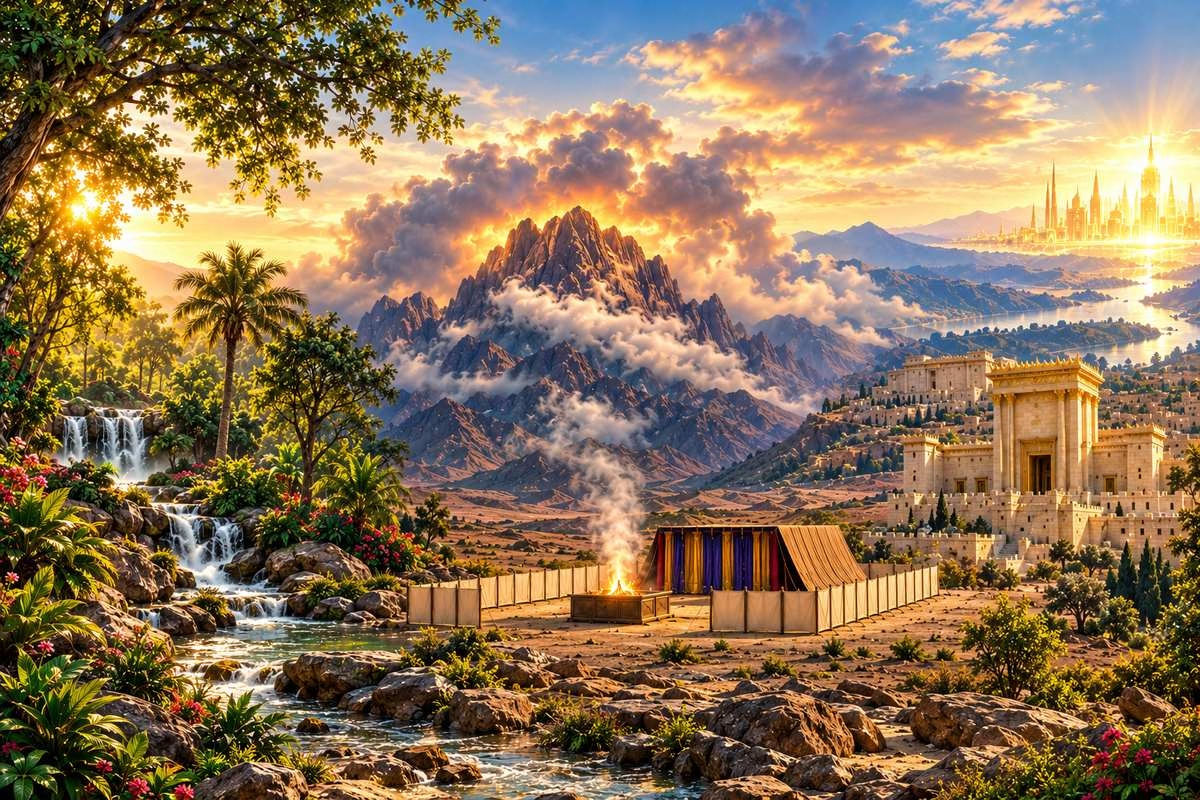
Eden → Sinai → Tabernacle → Temple → Christ → New Creation.
At Eden, man was driven from God’s presence. At Sinai, God brought a redeemed people near. In the Tabernacle and Temple, God dwelt in their midst. In Christ, the way into God’s presence has been opened.
And in the New Creation, the purpose toward which the entire sanctuary story has been moving will finally be realized:
“Behold, the tabernacle of God is with men.”
And as such we should be thankful for the great access that we have now, but look forward in anticipation for the even greater access we will have at Jesus’ second advent!
HCC Blog: https://holycovenantchurch.com/blog/
Sermon Link: https://www.youtube.com/watch?v=PFN36aObxyQ
Previous Blog Post: https://holycovenantchurch.com/grandchildren-a-crowning-blessing/
For Further Reading
For those interested in exploring these connections further:
Gordon J. Wenham, “Sanctuary Symbolism in the Garden of Eden Story.” Wenham identifies numerous correspondences between Eden and Israel’s later sanctuary and is an important early treatment of the subject.
G. K. Beale, The Temple and the Church’s Mission: A Biblical Theology of the Dwelling Place of God. Beale develops the Eden-sanctuary connection extensively, including the three-fold structure of sacred space and its fulfillment in the New Creation.
G. K. Beale, “Eden, the Temple, and the Church’s Mission in the New Creation,” Journal of the Evangelical Theological Society 48 (2005). This provides a shorter treatment of many of the themes developed in Beale’s larger work.
John H. Walton has also written extensively about Eden as sacred space and Adam’s priest-like vocation, though his broader understanding of temple and creation differs at points from Beale’s