
Understanding the Covenant Structure of Exodus 20
Introduction
This past Lord’s Day, we continued our journey through Exodus with a sermon entitled Covenant Proclaimed. Having considered the covenant proposed, the preparation of the people, and the glorious presence of Yahweh upon the mountain, we turned our attention to the words God himself spoke to his redeemed people.
Our primary concern was how Israel was to respond to the covenant being proclaimed. But there is another fascinating dimension to Exodus 20 that deserves our attention: the structure of the covenant itself.
The Ten Commandments were not given as an isolated collection of moral obligations. They were proclaimed within the context of a covenant relationship between Yahweh, the great King, and the people whom he had graciously redeemed.
Understanding this structure helps us appreciate the relationship between grace and obedience, the significance of God’s presence among his people, and ultimately the greater covenant established through Jesus Christ.
A Covenant from the Great King
In his influential work, Treaty of the Great King: The Covenant Structure of Deuteronomy (1963), Old Testament scholar Meredith G. Kline demonstrated remarkable similarities between the biblical covenant documents and the suzerainty treaties of the ancient Near East.
These treaties were formal arrangements in which a great king, or suzerain, established his authority over a lesser king or people, known as vassals. They commonly contained several recognizable features: a preamble identifying the king, a historical prologue recounting his previous dealings with the people, stipulations outlining their obligations, provisions for preserving and publicly reading the treaty, and blessings and curses associated with covenant faithfulness or rebellion.
Kline argued that this treaty pattern is especially evident in Deuteronomy. But he also recognized that the Ten Commandments themselves reflect the structure of a covenant document.
In his essay “The Two Tables of the Covenant,” included in Treaty of the Great King, Kline describes the Decalogue as a “covenant in miniature.”
Consider the opening words of Exodus 20:
“And God spoke all these words, saying: ‘I am the LORD your God, who brought you out of the land of Egypt, out of the house of bondage.'” (Exodus 20:1–2, NKJV)
Before issuing a single commandment, Yahweh identifies himself as the covenant Lord and recounts what he has done for his people.
The declaration “I am the LORD your God” serves as the covenant preamble, identifying the sovereign King. The words “who brought you out of the land of Egypt” function as the historical prologue, reminding Israel of the redemption that preceded their covenant obligations.
Only then does God begin to proclaim the commandments.
The order is significant: redemption precedes obligation.
God does not command Israel to obey in order to be delivered from Egypt. He delivers them and then instructs them how to live as his covenant people.
The Grace Behind the Commandments
Interestingly, the relationship between God’s gracious dealings and Israel’s obedience was recognized long before modern scholars began comparing biblical covenants with ancient treaties.
John Calvin, writing in his Institutes of the Christian Religion (2.8.13–15), explains that the opening declaration of Exodus 20 serves as a preface to the entire law. God establishes his authority to command while reminding Israel of his previous kindness, thereby calling forth gratitude and obedience.
This is a profoundly pastoral observation.
God could have begun the Ten Commandments with a bare assertion of authority. As the Creator and sovereign Lord of all things, he certainly possessed the right to command obedience.
Instead, he reminds Israel of his gracious intervention on their behalf.
He is the God who heard their cries, remembered his covenant with Abraham, Isaac, and Jacob, defeated Pharaoh, and brought his people through the sea.
Even more remarkably, in Exodus 19:4, God explains the purpose of that redemption: “I … brought you to Myself.”
This was never merely about escaping Egypt or receiving a new collection of laws. It was about belonging to Yahweh.
The commandments must therefore be read within the context of that relationship. They reveal what covenant faithfulness looks like among a redeemed people who have been brought into fellowship with the living God.
The Commandments as Covenant Stipulations
O. Palmer Robertson, in The Christ of the Covenants, famously defines a covenant as “a bond in blood sovereignly administered.”
Robertson’s definition reminds us that biblical covenants are not casual arrangements between equals. They establish solemn relationships involving genuine responsibilities, promises, and consequences.
This is precisely what we encounter at Sinai.
The commandments of Exodus 20:3–17 function as covenant stipulations, defining Israel’s responsibilities before Yahweh.
The first commandments establish exclusive loyalty to God. Israel must worship him alone, reject idols, honor his name, and keep his Sabbath holy.
The remaining commandments establish the duties owed to parents and neighbors. They govern the preservation of life, marriage, property, truth, and the proper ordering of human desires.
These commandments are not arbitrary regulations. They reveal the righteous character of the King and establish how his people are to live under his rule.
This also explains why Jesus summarizes the law through the two great commandments: love for God and love for neighbor (Matthew 22:37–40).
Love is not a replacement for obedience. Rather, rightly understood, love gives expression to obedience.
Covenant obedience is love expressed in action.
The Two Tablets and the Covenant Documents
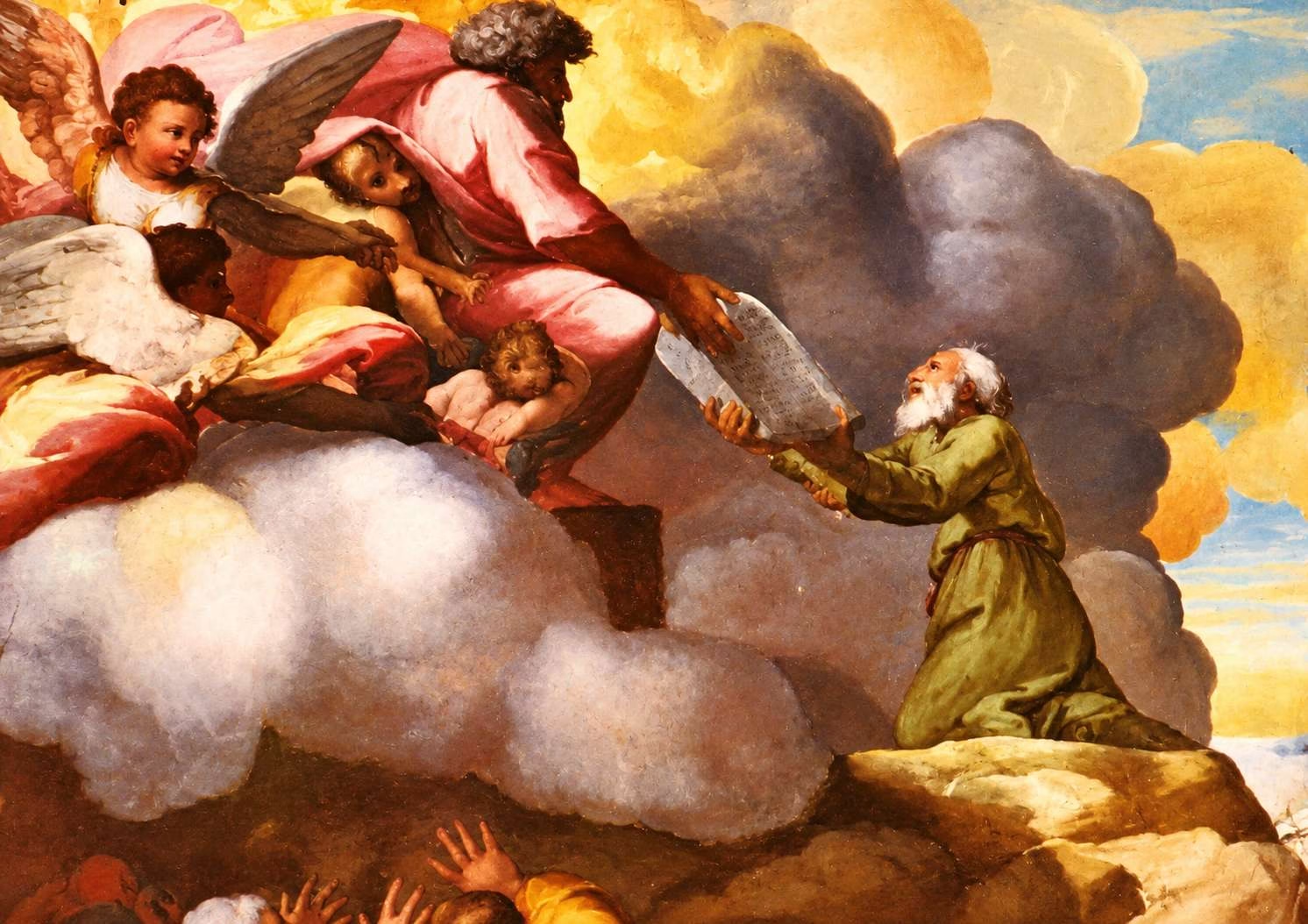
There is another fascinating feature of the covenant that we frequently overlook: the two tablets upon which the commandments were written.
Most Christians have probably seen artistic depictions of the Ten Commandments divided between two tablets, with the commandments concerning God on one and those concerning our neighbor on the other.
But Kline offers another explanation.
In Treaty of the Great King, he argues that the two tablets may have been duplicate copies of the entire covenant document, following the practice of ancient Near Eastern treaties.
Ordinarily, copies of such treaties could be deposited in the sanctuaries associated with the respective parties, where the gods were understood to serve as witnesses to the agreement.
But something remarkable happens with Israel’s covenant.
Both tablets are deposited together in the Ark of the Covenant.
Deuteronomy 10:5 records Moses’ words:
“Then I turned and came down from the mountain, and put the tablets in the ark which I had made; and there they are, just as the LORD commanded me.” (NKJV)
Why would both copies be placed in the same location?
Kline suggests that the answer lies in the unique nature of Israel’s covenant relationship. Yahweh was not merely the great King who ruled over Israel. He was also the God who graciously dwelt among his people.
Consequently, the sanctuary of the great King was located in the midst of the nation he had redeemed.
Both covenant documents could therefore be deposited together.
Although Scripture does not explicitly state that each tablet contained the complete Decalogue, Kline’s proposal offers a compelling explanation of the tablets’ covenantal significance.
And there is more.
The Ark was placed in the Most Holy Place, beneath the mercy seat, where Yahweh symbolically dwelt enthroned above the cherubim. Scripture also describes the Ark in connection with God’s footstool (1 Chronicles 28:2).
Thus, the covenant documents rested beneath the symbolic throne of the great King.
They were enduring witnesses to the covenant relationship between Yahweh and Israel.
The Book of the Law was likewise placed beside the Ark as a witness (Deuteronomy 31:24–26), and provisions were made for its public reading so that future generations would hear and learn to fear Yahweh (Deuteronomy 31:9–13).
The covenant was not to be forgotten. It was to be preserved, proclaimed, remembered, and obeyed.
But perhaps the most glorious feature of this arrangement is that the covenant documents were stored in the very sanctuary where God had promised to dwell among his people.
Once again, we are reminded of the words of Exodus 19:4: “I … brought you to Myself.”
Grace Does Not Eliminate Responsibility
We must be careful not to conclude that because redemption preceded the commandments, Israel’s obedience was somehow optional.
The covenant established genuine responsibilities, and those responsibilities carried real consequences.
Kline’s broader analysis of the Mosaic covenant helps us appreciate this dimension. The covenant included stipulations and sanctions, with blessings for faithfulness and curses for disobedience, developed more fully in Leviticus 26 and Deuteronomy 28.
Kline also argues that Israel’s continued possession of the typological kingdom in Canaan was conditioned upon covenant obedience. This did not mean that sinners could merit eternal salvation through keeping the Mosaic law. Rather, the Mosaic administration possessed a distinctive legal and typological function within redemptive history.
God’s gracious redemption of Israel did not eliminate the seriousness of their covenant responsibilities.
This challenges a common misconception among Christians today.
We sometimes speak as though grace and obedience stand in opposition to one another. Grace, we imagine, means freedom from obligation.
But Scripture presents a very different picture.
God’s grace establishes a new relationship, and that relationship brings with it new responsibilities.
The Westminster Confession of Faith, chapter 19, section 6, explains that believers are not under the law as a covenant of works by which they are justified or condemned, yet the law remains useful in directing their lives according to God’s will.
In other words, the law does not become the means of our justification, but neither does it become irrelevant to our sanctification.
Grace does not excuse obedience; it expects and enables it.
Conclusion: The Greater Covenant and the Greater Redeemer
Of course, the covenant at Sinai was not the final expression of God’s redemptive purposes. Its priesthood, sacrifices, ceremonial regulations, and covenant administration anticipated the coming of Jesus Christ.
Where Israel repeatedly failed in covenant faithfulness, Christ rendered perfect obedience to his Father. Where sinners stand condemned by God’s righteous law, Christ bore the curse due to their transgressions (Galatians 3:13). Through his life, death, and resurrection, Christ established the new covenant, securing forgiveness and the gift of the Holy Spirit for his people.
Jeremiah 31:33 promises that God will write his law upon the hearts of his people. Ezekiel 36:26–27 further promises that God will give his people a new heart and put his Spirit within them, causing them to walk in his statutes. The God who commands obedience also provides the grace necessary for his people to obey.
And this brings us back to the practical implications of the covenant. Whether we are struggling with anger, discontentment, lust, or bitterness, our obedience must flow from remembering who God is and what he has done for us. We do not obey to secure his favor, but because we have received his favor in Christ. And when we fail, we confess our sins, look to our faithful Savior, and continue walking in grateful obedience.
Christians are not placed under the Mosaic covenant as though its entire administration remained unchanged. Rather, through Christ, we receive the fulfillment of God’s covenant promises and are called to live in obedience to our risen Lord.
The law continues to reveal God’s holiness and direct our lives, but our standing before him rests entirely upon the righteousness of Jesus Christ.
HCC Blog: https://holycovenantchurch.com/blog/
Sermon Link: https://www.youtube.com/watch?v=ahQfqpNBQ2w&t=4s
Previous Blog Post: https://holycovenantchurch.com/before-the-tabernacle-eden-sinai-and-the-presence-of-god/
Sources and Further Reading
- Meredith G. Kline, Treaty of the Great King: The Covenant Structure of Deuteronomy (Eerdmans, 1963), especially “The Two Tables of the Covenant,” pp. 13–27.
- John Calvin, Institutes of the Christian Religion, 2.8.13–15.
- O. Palmer Robertson, The Christ of the Covenants (Presbyterian and Reformed, 1980), especially chapter 1.
- Westminster Confession of Faith, chapter 19, especially sections 5–7.
- Meredith G. Kline, The Structure of Biblical Authority.