
Introduction
Few questions in biblical theology generate more heat than the relationship between Israel and the Church. And few labels shut down the discussion more quickly than “supersessionism” or “replacement theology.”
The terms are often used interchangeably, though there is a helpful distinction between them. Supersessionism is commonly used for the belief that the Church now occupies the covenant position once held by Israel, with Israel’s covenant role reaching its fulfillment under the New Covenant in Christ and His Church. Replacement theology is often used more negatively for the idea that God rejected Israel because of her unbelief and replaced her with the Church—as though Israel were Plan A, Israel failed, and God moved on to Plan B.
But that is not the argument being made here.
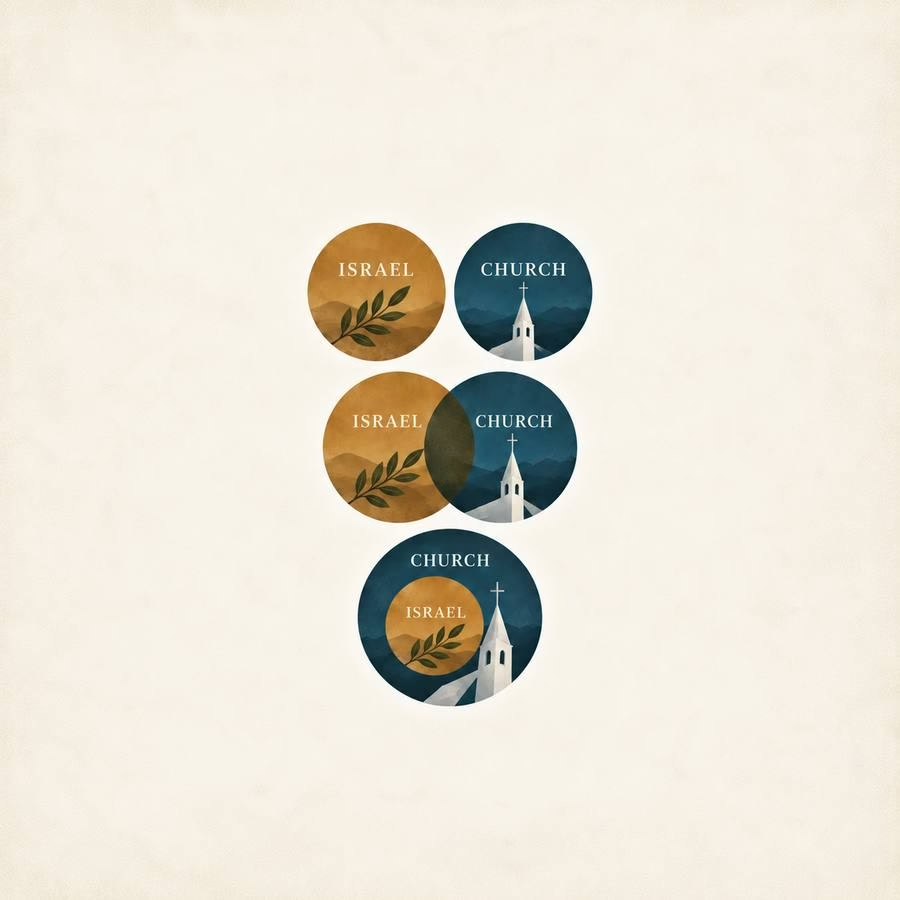
The biblical argument is not that the Church replaces Israel, as though God discarded one people and started over with another. Rather, God fulfills His purposes for Israel in Israel’s Messiah, Jesus Christ, and gathers believing Jews and Gentiles together in Him as one covenant people.
One of the clearest places to see this is by reading Exodus 19 alongside 1 Peter 2.
From Sinai to Peter
After redeeming Israel from Egypt, God brought His people to Mount Sinai. Before giving the Ten Commandments, He declared their identity and calling:
“And you shall be to Me a kingdom of priests and a holy nation.”
—Exodus 19:6
The order is important. God did not tell Israel to become a kingdom of priests so that He would redeem them. He had already redeemed them. He brought them through the blood of the Passover and through the waters of the Red Sea, and then He told His redeemed people who they were. They were His special treasure, His kingdom of priests, and His holy nation.
Yet Israel’s calling was never merely about Israel. Long before Sinai, God had promised Abraham, “And in you all the families of the earth shall be blessed” (Genesis 12:3). Israel was set apart from the nations, but ultimately God intended through Israel to bring blessing to the nations.
That makes Peter’s language in the New Testament striking. Writing to Christians scattered throughout Asia Minor, he declares:
“But you are a chosen generation, a royal priesthood, a holy nation, His own special people.”
—1 Peter 2:9
The connection with Exodus 19 is unmistakable. Israel was God’s special treasure, kingdom of priests, and holy nation. Now Peter calls the Church a chosen generation, royal priesthood, holy nation, and God’s own special people.
This is not accidental. Peter deliberately takes the covenant language spoken over Israel at Sinai and applies it to the Church. He goes even further in the next verse: “Who once were not a people but are now the people of God” (1 Peter 2:10).
We should not be afraid to make a connection that Peter himself makes. The question, then, is how those who were once “not a people” became “the people of God.”
Paul helps us answer that question.
Grafted In, Not Replaced
In Romans 11, Paul pictures God’s covenant people as an olive tree. Some natural branches have been broken off because of unbelief, while believing Gentiles are described as wild olive branches. Paul tells the Gentiles:
“And you, being a wild olive tree, were grafted in among them, and with them became a partaker of the root and fatness of the olive tree.”
—Romans 11:17
Notice what does not happen. God does not uproot Israel’s tree and plant a Church tree. Neither does He plant a second tree beside Israel’s tree. Instead, Gentiles are grafted into the existing tree and become partakers of its root.
The picture is not replacement. It is incorporation.
This is also why Paul warns Gentile Christians, “Do not boast against the branches” (Romans 11:18). Gentiles have no grounds for arrogance toward unbelieving Jews. We are wild branches graciously grafted into a tree that was not naturally ours. As Paul reminds us, we do not support the root; the root supports us.
This is one place where this understanding differs from classic dispensationalism. Dispensational theology has historically maintained a strong distinction between Israel and the Church, often arguing that promises specifically made to national Israel must ultimately be fulfilled specifically to national Israel.
There is an important concern behind that position that should be affirmed: God keeps His promises. We must never interpret Scripture in a way that makes God unfaithful to what He promised Abraham, Isaac, Jacob, David, and their descendants.
But the real question is not whether God keeps His promises. The question is how the New Testament says He keeps them.
Peter applies Israel’s covenant titles to the Church. Paul gives us one olive tree rather than two. And Ephesians 2 makes the unity of Jew and Gentile in Christ even clearer.
Those Who Were Far Off…
Paul describes the former condition of the Gentiles as “aliens from the commonwealth of Israel and strangers from the covenants of promise” (Ephesians 2:12). They were outsiders. They did not possess the covenants, promises, or citizenship that belonged to Israel.
But then something remarkable happened:
“But now in Christ Jesus you who once were far off have been brought near by the blood of Christ.”
—Ephesians 2:13
Paul does not say that those who were far off have been given a different covenant people with a different set of promises. He says they have been brought near.
Near to what? Near to the very things from which they had previously been alienated: the covenant promises and the people of God.
Christ, Paul says, “has made both one” (Ephesians 2:14), creating “in Himself one new man from the two” (v. 15). Through the cross, Jew and Gentile are reconciled to God “in one body” (v. 16).
Paul’s conclusion is therefore perfectly natural:
“Now, therefore, you are no longer strangers and foreigners, but fellow citizens with the saints and members of the household of God.”
—Ephesians 2:19
The strangers have become fellow citizens. The outsiders have been brought inside. Those who were once alienated from the covenants of promise have become members of God’s household.
Again, this is not replacement. It is fulfillment and incorporation.
The Promise Was Always Bigger Than Israel
None of this should surprise us because God’s promise to Abraham always anticipated the nations. God had promised that in Abraham “all the families of the earth shall be blessed” (Genesis 12:3). Israel’s election was never intended to terminate upon Israel. Through Abraham’s Seed, blessing would eventually flow to the nations.
And that Seed is Christ.
This is why Paul can make the remarkable statement:
“And if you are Christ’s, then you are Abraham’s seed, and heirs according to the promise.”
—Galatians 3:29
Gentile Christians do not receive an unrelated set of promises. Because they belong to Christ, they become Abraham’s seed and heirs according to the promise.
The promise has not been abandoned. It has blossomed.
And this is where the whole question must ultimately be settled. Jesus is the Seed of Abraham. He is the faithful Israelite, the Son of David, the King, the true Temple, the great High Priest, and Israel’s Messiah. The promises of God therefore reach their fulfillment in Him.
As Paul writes:
“For all the promises of God in Him are Yes, and in Him Amen.”
—2 Corinthians 1:20
The question is not, Does God keep His promises to Israel? Of course He does.
The question is, Where do those promises find their fulfillment?
The apostolic answer is: in Jesus Christ.
And What About Ethnic Israel?
None of this means that God is finished with ethnic Jews. Romans 11 warns Gentile Christians against precisely that kind of thinking. The natural branches can be grafted in again, and Paul eventually declares, “And so all Israel will be saved” (Romans 11:26).
Christians disagree about exactly how that statement will be fulfilled, including whether Paul anticipates a large-scale future conversion of ethnic Israel. But whatever position one takes on that question, one truth remains clear: Jewish salvation does not occur through a separate covenant, a separate gospel, or a separate Messiah.
Jew and Gentile alike come to God through Jesus Christ.
When Jewish people believe in Christ, they are not entering a Gentile religion. They are embracing Israel’s Messiah and, using Paul’s imagery, being grafted again into their own olive tree.
And now the movement from Exodus 19 to 1 Peter 2 comes into focus.
At Sinai, God called Israel His special treasure, a kingdom of priests, and a holy nation. Then Christ came. Those who were far off were brought near. Wild branches were grafted into the olive tree. Those who were strangers became fellow citizens. Jew and Gentile were made one new man.
And so Peter can look at the Church—Jew and Gentile united to Israel’s Messiah—and declare:
“You are a chosen generation, a royal priesthood, a holy nation, His own special people.”
—1 Peter 2:9
This is also why Christ commands His disciples, “Go therefore and make disciples of all the nations” (Matthew 28:19). The kingdom of priests declared at Sinai is now being gathered from the nations of the earth.
Replacement or Fulfillment?
So did the Church replace Israel?
I think that language misses the richness of the biblical story. The movement of Scripture is not Israel → failure → rejection → Church. Nor does the New Testament leave us with two unrelated covenant peoples moving along separate tracks.
Instead, we see God’s covenant promises moving through Israel to Israel’s Messiah, and through Him to believing Jews and Gentiles who are united together as one people and sent into all the nations.
God has not thrown away His promises. He has kept them.
Those who were far off have been brought near. Those who were strangers are now fellow citizens. Wild branches have been grafted into the tree. Those who belong to Christ are Abraham’s seed and heirs according to the promise.
This is not the supersession of Israel. It is not the abandonment of Israel. And it is not God replacing one failed people with another.
It is the fulfillment of God’s covenant promises in Israel’s Messiah, Jesus Christ.
One people. One Messiah. One story.
HCC Blog: https://holycovenantchurch.com/blog/
Sermon Link: https://www.youtube.com/@HolyCovenantChurch/streams
Previous Blog Post: https://holycovenantchurch.com/the-bible-on-fathers-and-sons-in-law/