
Introduction
Every October, Protestants have an opportunity to remember and celebrate one of the most consequential events in the history of the Church: the Protestant Reformation. Yet in recent years, a number of prominent Protestants have announced their departures for Rome or Constantinople. They have, as the expressions go, swam the Tiber or swam the Bosphorus.
Their reasons vary, but a recurring theme is the desire for something ancient, rooted, and historically connected to the Church Christ established. They long for doctrinal stability, historical continuity, reverent worship, and a faith that transcends the individualism and novelty characteristic of much modern evangelicalism.
And frankly, we ought to sympathize with many of these concerns.
Much of contemporary Protestantism has forgotten its history, neglected its confessions, and abandoned its liturgical inheritance. For those raised in such environments, discovering the Church Fathers, ancient creeds, and historic liturgies can feel like discovering an entirely different religion.
But must we abandon Protestantism to recover the ancient Church?
I would suggest that the answer is a resounding no. Indeed, much of what these converts seek already belongs to our Protestant inheritance, particularly within the classical Reformed tradition. We are Reformed, not rootless.
What is important to remember is that the Reformation was not an attempt to establish a new Church. It was an effort to reform the existing Church, removing corruptions that had accumulated over centuries and recovering the faith once for all delivered to the saints (Jude 3).
Our family history stretches back through Geneva and Wittenberg, through medieval Christendom, through Augustine and Athanasius, and ultimately to the apostles themselves. That heritage is worth celebrating.
1. Our Doctrinal Connection: We Confess the Ancient Faith
One persistent misconception about Protestantism is that its theological history begins in the sixteenth century, as though Luther and Calvin introduced something fundamentally new. But the Reformers understood their work quite differently.
They did not reject the ancient creeds; they embraced them. They did not dismiss the Church Fathers; they studied, cited, and appealed to them. They did not believe the Holy Spirit had abandoned the Church between the apostles and the Reformation.
Consider the great ecumenical creeds. We confess the Apostles’ Creed, affirming the triune God, the incarnation, and the resurrection of the body. We confess the Nicene Creed, declaring the Son to be eternally begotten of the Father and of one substance with Him. We embrace Chalcedon’s confession that Jesus Christ is one person in two natures, fully God and fully man.
These are not foreign doctrines borrowed from another religion. They are part of our inheritance. Indeed, the Belgic Confession explicitly affirms the Apostles’, Nicene, and Athanasian creeds (Article 9), while the Westminster Confession stands firmly within the ancient Trinitarian and Christological tradition.
As Matthew Barrett demonstrates in The Reformation as Renewal, the Reformers understood their work in conversation with the ancient and medieval Church. They sought to preserve what was faithful while correcting what had departed from Scripture. Calvin, in his prefatory address to Francis I in the Institutes, even challenged the accusation that Reformation doctrine was novel, appealing to the testimony of the ancient Church.
This raises an important question: What makes a church truly catholic?
Is catholicity merely a matter of institutional continuity, or does it also require fidelity to the doctrine handed down by the apostles?
The Reformed tradition has historically insisted upon the latter. The Church’s catholicity cannot be reduced to tracing an institutional lineage. As the Belgic Confession explains in Article 29, the true Church is recognized by the pure preaching of the gospel, the proper administration of the sacraments, and the exercise of church discipline.
This does not mean that history or tradition is unimportant. Quite the contrary. As Michael Allen and Scott Swain argue in Reformed Catholicity, being Reformed and being catholic are not competing commitments. We receive the theological inheritance of the Church with gratitude while submitting it to the final authority of Scripture.
This is precisely what sola Scriptura means. It does not demand that we disregard the Church’s history or interpret Scripture independently of those who preceded us. Rather, it recognizes that the Church, including her councils, confessions, and teachers, remains subject to the written Word of God.
The question, then, is not simply whether Protestants can demonstrate continuity with the ancient Church, but which tradition has most faithfully preserved the apostolic faith. The Reformers did not concede that Rome possessed the ancient Church while they offered something new. They contended that fidelity to the ancient Church required reform.
2. Our Cultural Connection: We Are Heirs of Christian Civilization
Our connection to the ancient Church is not merely doctrinal. It is also historical and cultural.
Christianity has never existed in a vacuum. Across the centuries, Christians developed patterns of education, family life, charity, music, architecture, and literature that reflected their understanding of the world under the lordship of Jesus Christ.
And Protestants are heirs of this civilization.
We need not surrender the thousand years preceding the Reformation to Rome or the East. Augustine and Athanasius belong to our history, as do the early martyrs, the bishops who defended orthodoxy, the medieval scholars who preserved and studied Scripture, and the countless ordinary Christians who confessed Christ long before the sixteenth century.
Of course, acknowledging this inheritance does not mean approving everything done in the name of Christendom. Christian history includes serious errors, grievous sins, and practices that desperately needed reform. But those failures do not erase God’s work throughout the centuries.
The Reformers themselves were products of this long Christian history. Their theological vocabulary, educational methods, and intellectual categories were shaped by the generations preceding them. The Reformation did not emerge from a cultural wilderness. It emerged from within Christian civilization and sought to reform it.
This is particularly important in an age when Christianity is frequently reduced to an individual relationship with Jesus, detached from the generations that preceded us and those that will follow.
But the Church is not merely a collection of isolated individuals. It is a people with a history, a common confession, and an inheritance to receive and pass along.
We ought to know that history, read its great books, learn from its theological controversies, and teach our children that they belong to something much older and greater than themselves.
3. Our Liturgical Connection: We Worship with the Historic Church
Perhaps nowhere is the modern Protestant disconnect from Christian antiquity more apparent than in public worship.
For many evangelicals, worship consists primarily of contemporary songs followed by a sermon. The structure is often informal, the sacraments infrequent, and the sense of historical continuity nearly absent. Consequently, when such Christians encounter the ordered, reverent, and sacramental worship of Roman Catholicism or Eastern Orthodoxy, they discover something profoundly different from their own experience.
But historic Protestantism possesses a rich liturgical inheritance of its own.
The Reformers did not reject ordered worship; they reformed it according to Scripture. They retained public prayers, the reading and preaching of Scripture, congregational singing, confession of sin, baptism, the Lord’s Supper, and the blessing of God’s people.
At Holy Covenant Church, we understand Lord’s Day worship as covenant renewal. God summons His people into His presence, cleanses them through His grace, consecrates them by His Word, communes with them at His Table, and commissions them with His blessing. This is not an attempt to manufacture an ancient aesthetic, but to worship according to Scripture while recognizing our connection to the historic Church.
That connection is also evident in the songs we sing. Our Cantus Christi hymnal preserves hymns rooted in Christian antiquity, including Of the Father’s Love Begotten, based on the fourth-century poetry of Prudentius, and Let All Mortal Flesh Keep Silence, drawn from the ancient Liturgy of St. James. When we sing these hymns, we join our voices to the testimony of Christians who worshiped the same triune God centuries before the Reformation.
Of course, ancient worship is not necessarily faithful worship simply because it is ancient. The Reformers understood that liturgical practices, like doctrines, must be tested by Scripture. Antiquity is valuable, but antiquity alone does not establish divine authorization.
Nevertheless, where the Church has faithfully confessed the truth and worshiped the triune God according to His Word, we should receive that inheritance with gratitude.
As Hughes Oliphant Old demonstrates in Worship: Reformed According to Scripture, Reformed worship stands in conversation with the biblical and historical practices of Christian worship. Our commitment to the ordinary means of grace, the centrality of the Word, and the regular administration of the sacraments reflects a concern to preserve the substance of Christian worship rather than merely reproduce its outward appearance.
When we gather each Lord’s Day, confess our sins, hear the Scriptures, recite the ancient creeds, sing the songs of the Church through the ages, and feast at the Lord’s Table, we are not participating in a religion invented five hundred years ago. We are worshiping the same triune God whom Augustine worshiped, whom Athanasius defended, and whom the apostles proclaimed.
The Reformation Is Worth Celebrating
None of this requires us to deny the sincerity of those who have entered Roman Catholicism or Eastern Orthodoxy, nor should we pretend that our theological differences are insignificant. They involve substantial disagreements about authority, justification, the sacraments, and the nature of the Church.
But neither should we accept the claim that historical Christianity belongs exclusively to Rome or Constantinople.
The Church belongs to Jesus Christ.
The Reformers did not understand themselves to be establishing a rival religion. They sought to preserve what was true, correct what was erroneous, and restore what had been obscured. Their conviction was not that the Church had ceased to exist and needed to be reinvented, but that it must continually be reformed according to God’s Word.
And that remains our calling.
We should be grateful for Luther, Calvin, Bucer, and our Reformed forefathers. But our gratitude must reach further back, to the ancient martyrs, the Church Fathers, the great councils, the medieval theologians, and the ordinary saints through whom God preserved His Church.
For the Reformation was not the beginning of our history. It was a significant chapter in a much longer story.
So this Reformation Day, let us celebrate our inheritance without embarrassment or apology. Let us recover our confessions, deepen our acquaintance with the Church Fathers, cultivate a distinctly Christian culture, and worship the Lord with reverence, joy, and biblical fidelity.
We need not cross the Tiber or the Bosphorus to find our Christian ancestors. We encounter their testimony in our confessions, inherit their wisdom in our theological tradition, and join their praises every Lord’s Day. The ancient Church is not someone else’s family history. It is ours too.
We are not orphans. We are heirs. We are Reformed, not rootless.
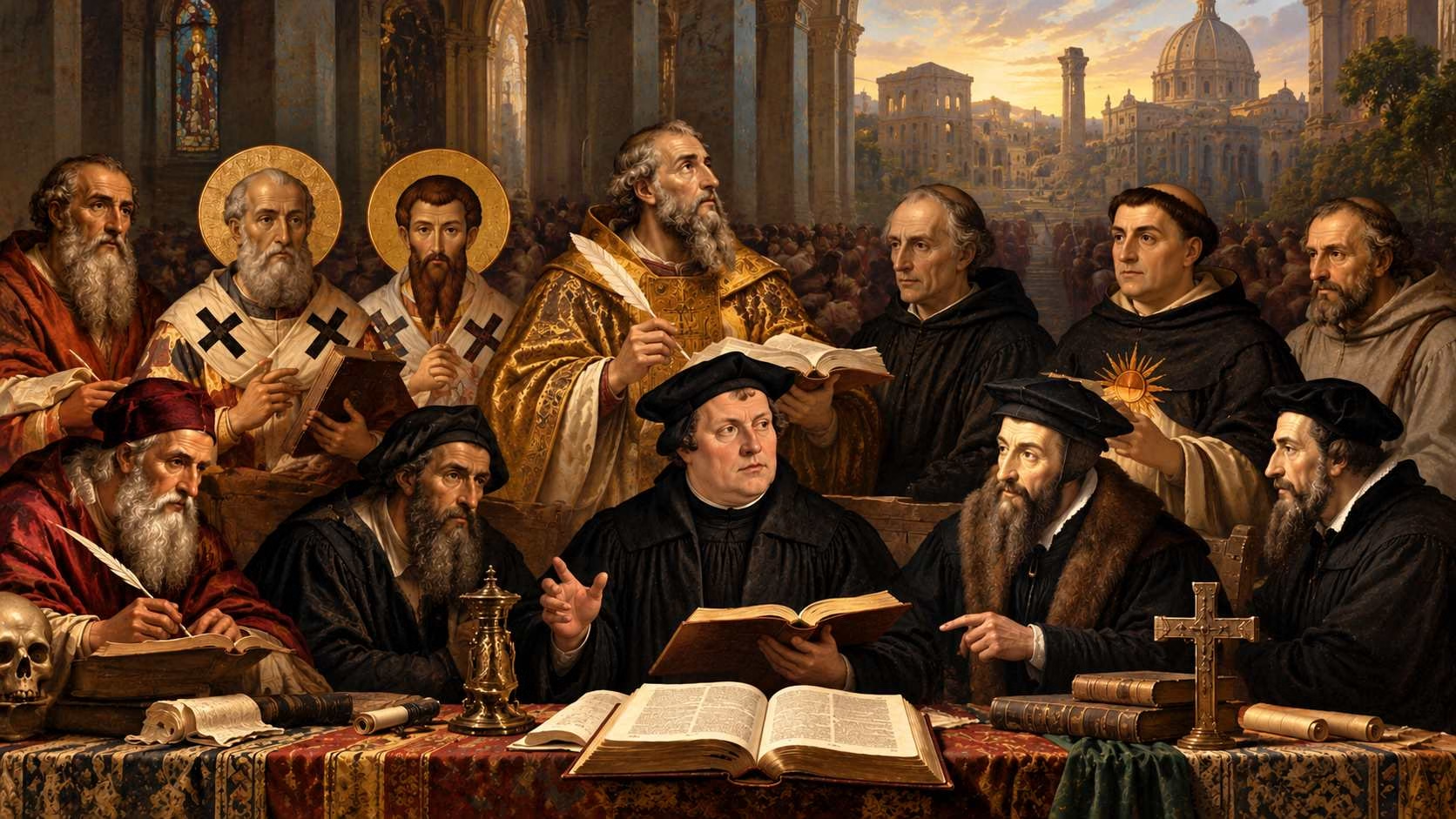
Note: For fun, see if you can guess the names of the men pictured in the image associated with this post.
HCC Blog: https://holycovenantchurch.com/blog/
More info about the CREC: https://crechurches.org
Previous post: https://holycovenantchurch.com/theonomy-does-gods-law-still-apply-today/