
Introduction
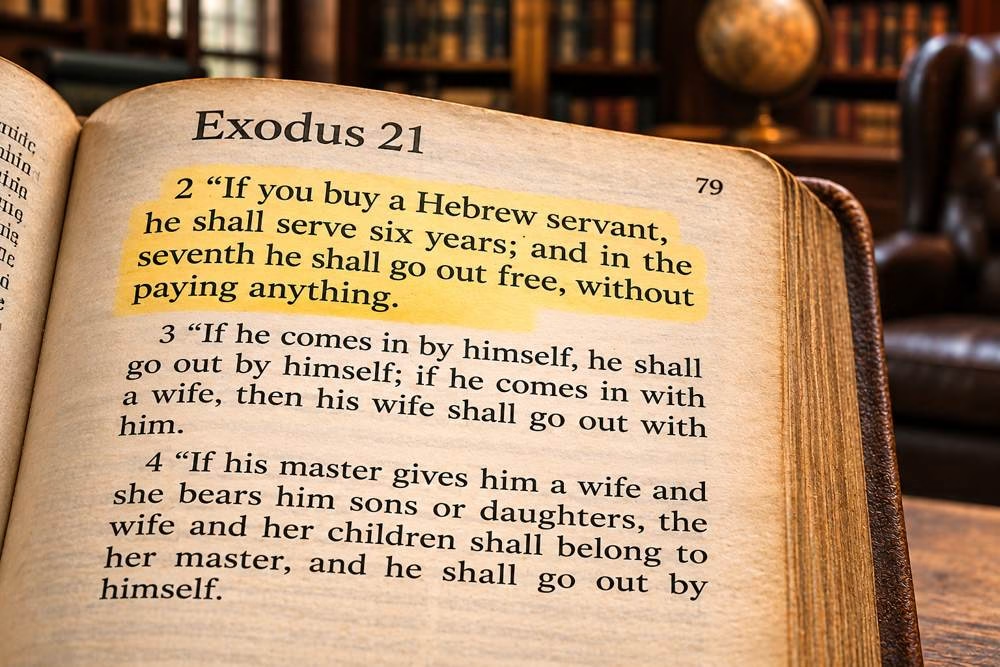
In our recent sermon on Exodus 21:2–11, we made the case that God began his case laws with the treatment of servants to remind Israel that, having been redeemed from bondage in Egypt, they were now to reflect that redemption in their treatment of others, particularly male and female slaves.
But let’s face it, the subject of slavery in the Bible can make Christians rather uncomfortable, perhaps even embarrassed. Imagine finally convincing that unbelieving friend you’ve been inviting for months to visit church. You greet him warmly, introduce him around, and settle into the pew, quietly praying that the sermon will be especially encouraging. Then the pastor announces the text: “If you buy a Hebrew servant…” (Exodus 21:2). Wonderful. You’ve spent six months convincing him to come, and now you’re hoping the pastor can explain ancient Near Eastern labor practices in thirty minutes or less. Suddenly, predestination doesn’t seem nearly so controversial.
Our discomfort is understandable, particularly given the horrors of American slavery. But are we embarrassed by what Scripture actually teaches, or by what we assume it teaches?
What Does the Bible Mean by Slavery?
When we hear the word slave, we naturally think of someone reduced to property, deprived of liberty, and subjected to exploitation. For Americans, that image is largely shaped by our nation’s tragic history of race-based chattel slavery.
But the Bible’s vocabulary is considerably broader.
The principal Hebrew word is ʿebed (עֶבֶד), derived from ʿabad (עָבַד), meaning to work, serve, or labor. Depending upon the context, an ʿebed could be a slave, household servant, royal official, or someone serving another in a position of dependence.
Consider its range of usage. Abraham’s servant was entrusted with considerable responsibility (Genesis 24:2). Pharaoh’s servants included royal officials (Genesis 40:20). Moses and David were both called servants of the LORD (Joshua 1:1–2; 2 Samuel 7:5). Yet the same word describes the Hebrew servant purchased in Exodus 21:2.
The Old Testament also uses ʾamah (אָמָה) and shiphchah (שִׁפְחָה) for female servants or enslaved women. Similarly, the New Testament uses doulos (δοῦλος), meaning slave or bondservant. Paul identifies himself as a doulos of Jesus Christ (Romans 1:1), and Jesus himself took the form of a servant (Philippians 2:7).
The point is not that slavery was simply another word for employment. Rather, we must allow the context to determine what kind of service or bondage is being described instead of assuming that every occurrence refers to precisely the same institution.
Not All Slavery Was the Same
The ancient world contained various forms of servitude, and Scripture reflects these differences.
Some were brutally oppressive, as Israel experienced in Egypt (Exodus 1:11–14). Others arose from poverty, when someone entered another household to secure provision (Leviticus 25:39). Still others resulted from an inability to make restitution for theft (Exodus 22:3).
But doesn’t Exodus 21:2 explicitly speak of buying a servant? Indeed it does. The Hebrew word qanah means to purchase or acquire, and we should not soften its meaning. Yet neither should we assume that every such purchase resembled American chattel slavery. In cases of debt-related servitude, the purchaser acquired a legally recognized claim to another person’s labor. In Exodus 21, that claim was limited: after six years of service, the Hebrew servant was to go free without paying for his release.
As Old Testament scholar Jay Sklar explains, certain forms of servitude could provide economic security for those facing poverty. Under the humane conditions required by biblical law, such arrangements:
“could be said to be little different experientially from many kinds of paid employment in a cash economy.”¹
Such service could provide food, shelter, and the security of a stable household. For someone facing destitution, it could be a means of survival. Indeed, these benefits help explain why some servants voluntarily chose to remain with their masters rather than accept release (Exodus 21:5–6; Deuteronomy 15:16–17).
This does not mean every servant entered service voluntarily or that every master treated his servants faithfully. It simply means that ancient servitude was more varied than our modern assumptions might suggest.
But What About Permanent Slavery?
At this point, someone might reasonably object, “That’s all well and good for Hebrew servants, but what about Leviticus 25? Doesn’t God explicitly permit the Israelites to own foreign slaves permanently?”
It’s a fair question.
Leviticus 25:44–46 permits Israelites to acquire servants from surrounding nations and from foreigners living among them. Unlike Hebrew servants, these individuals did not enjoy the same automatic release provisions. Their service could continue indefinitely, and they could even be passed down as an inheritance.
There was a genuine distinction between Hebrew and non-Hebrew servants. But does that mean foreign servants were without rights or protections? Not at all.
As Sklar observes:
“Israelite masters did not have absolute control over their servants. Servants had legal protections that recognized and safeguarded their humanity.”²
Foreign servants enjoyed Sabbath rest (Exodus 20:10; 23:12), protection against serious bodily injury (Exodus 21:26–27), participation in the Passover upon circumcision (Exodus 12:44), and provision during the sabbatical year (Leviticus 25:6). Even foreign servants were entitled to rest, protection, and certain blessings of God’s covenant community.
Nor did permanent necessarily mean freedom was impossible. Serious injury could require a servant’s release (Exodus 21:26–27). Scripture also recognizes redemption by payment (Leviticus 25:47–49), though that particular provision concerns Israelites serving foreign masters rather than foreign servants.
Furthermore, Deuteronomy 23:15–16 forbade returning an escaped slave to his master and required that the fugitive be allowed to settle without oppression. Although commentators debate whether this applied to all runaway slaves or specifically those fleeing foreign masters, **the law provided refuge for the vulnerable rather than automatically enforcing a master’s claim of ownership.**³
Finally, Exodus 21:16 explicitly condemned kidnapping someone for enslavement or sale, a significant distinction when considering the horrors of the transatlantic slave trade.
None of this eliminates the difficulties of Leviticus 25, which permitted foreign servants to be held indefinitely and inherited. Nevertheless, even within this fallen institution, God’s law restrained the master’s authority and established protections for those under it.
And this brings us back to the larger point of our sermon: The Lord who delivered his people from Egypt did not give them permission to become little Pharaohs in their own households.
Several Important Reminders
1. Slavery Still Exists
It is easy for modern readers to turn up their noses at Scripture, imagining that we have progressed beyond such primitive institutions. After all, we are more enlightened, more civilized, and have abolished slavery. Or so we tell ourselves.
The uncomfortable truth is that slavery has not disappeared; it has simply taken different forms. Sex trafficking, child exploitation, forced labor, debt bondage, and forced marriage continue to enslave millions. According to the International Labour Organization, approximately 50 million people were living in modern slavery in 2021.⁴ Much of this exploitation operates illegally, hidden from public view and beyond effective protection.
We may have outlawed slavery, but we have hardly eradicated man’s willingness to enslave his neighbor. Perhaps we should be less inclined to congratulate ourselves on our supposed enlightenment and more concerned about the bondage occurring in our own world.
2. God’s Word Addresses the Real World
God did not give his law to an unfallen people living in paradise. He gave it to sinful people living in a world marked by poverty, injustice, and broken relationships. Consequently, we must distinguish between what Scripture regulates in a fallen world and what God established as his original design.
In Genesis 1:26–28, God created mankind in his image and gave man dominion over creation, not permission to exploit his fellow image-bearers. Oppression and exploitation are distortions of that original design.
Consider divorce. Jesus explains that Moses permitted divorce because of the hardness of men’s hearts, while directing his hearers back to God’s original design for marriage (Matthew 19:8). The regulation of a fallen circumstance does not necessarily constitute an endorsement of that circumstance as ideal.
Likewise, the laws concerning servitude addressed the realities of ancient Israel, restraining abuses, establishing obligations, and protecting the vulnerable. God’s Word does not ignore the consequences of sin; it addresses them while pointing us toward something better.
3. The Gospel Confronts Both Masters and Servants
The New Testament does not ignore slavery but addresses both masters and servants under the authority of Jesus Christ.
Servants are instructed to serve sincerely, as serving Christ himself (Ephesians 6:5–8). Masters, however, are commanded to abandon threats and remember that they too have a Master in heaven, with whom there is no partiality (Ephesians 6:9). Paul likewise commands masters to give their servants what is just and fair (Colossians 4:1).
Consider also Paul’s appeal to Philemon concerning Onesimus. Paul urges Philemon to receive him “no longer as a slave but more than a slave—a beloved brother” (Philemon 16, NKJV).
The gospel confronts the pride of the powerful, dignifies the lowly, and reminds both that they stand before the same Lord.
4. Our Redemption Must Shape Our Treatment of Others
This brings us back to the central point of our sermon. Israel had been redeemed from Egypt, and that redemption was to shape how they treated those under their authority.
And beloved, how much more should this be true of us? We have been redeemed from a far greater bondage, the bondage of sin, through the precious blood of Jesus Christ. Having received such mercy, how can we withhold mercy from others?
Employers, parents, husbands, and all who exercise authority must remember that we serve a Master who did not exploit our helplessness but graciously delivered us from it. Those who have been redeemed ought to reflect the character of their Redeemer.
5. Our Future Hope Is Complete Redemption
Finally, the case laws of Exodus were never intended to describe the world as it would always be. They addressed the realities of a fallen world while pointing beyond themselves to something better.
Israel’s redemption from Egypt was real, but it was not complete. Though delivered from Pharaoh, the Israelites still lived in a world marked by sin, suffering, and oppression. And so do we.
But a day is coming when all of that will end. Through the death and resurrection of Jesus Christ, God has secured a far greater redemption, one that will be brought to its glorious completion when he returns.
There will be no more exploitation, oppression, poverty, or bondage to sin. No one will need laws restraining wicked masters, because there will be no wickedness left to restrain. As Revelation 21:4 declares, there will be no more death, sorrow, crying, or pain, for the former things will have passed away.
Until that day, we are called to live as redeemed people in a fallen world, reflecting the justice and mercy of our Redeemer while eagerly awaiting the day when all things will be made new.
Footnotes
- Jay Sklar, Leviticus: An Introduction and Commentary, Tyndale Old Testament Commentaries, vol. 3, ed. David G. Firth (Downers Grove, IL: InterVarsity Press, 2013), 307–308. Sklar is quoting Christopher J. H. Wright (2004, 333) in the comparison with paid employment.
- Sklar, Leviticus, 307–308.
- Jeffrey H. Tigay, Deuteronomy, JPS Torah Commentary (Philadelphia: Jewish Publication Society, 1996), 215; Christopher J. H. Wright, Deuteronomy, New International Biblical Commentary (Peabody, MA: Hendrickson, 1996), 249–250. Tigay favors the interpretation that the law protects slaves escaping from foreign masters into Israel, while Wright argues for a broader application.
- International Labour Organization, Walk Free, and International Organization for Migration, Global Estimates of Modern Slavery: Forced Labour a d Forced Marriage (Geneva: ILO, 2022). The estimate refers to conditions in 2021.
HCC Blog: https://holycovenantchurch.com/blog/
Sermon Link: https://www.youtube.com/@HolyCovenantChurch/streams
Previous Blog Post: https://holycovenantchurch.com/reformed-not-rootless/