
Introduction
This past Lord’s Day, as we continued our study of the case laws in Exodus 21:33–22:15, we considered how God applies the Eighth Commandment, “You shall not steal” (Exodus 20:15). We saw that personal property is to be respected, protected, and restored.
While each of these principles is important, I want to return to the last one and consider it more closely, particularly how the biblical principle of restitution helps us better understand the gospel.
Making Right What Was Wrong
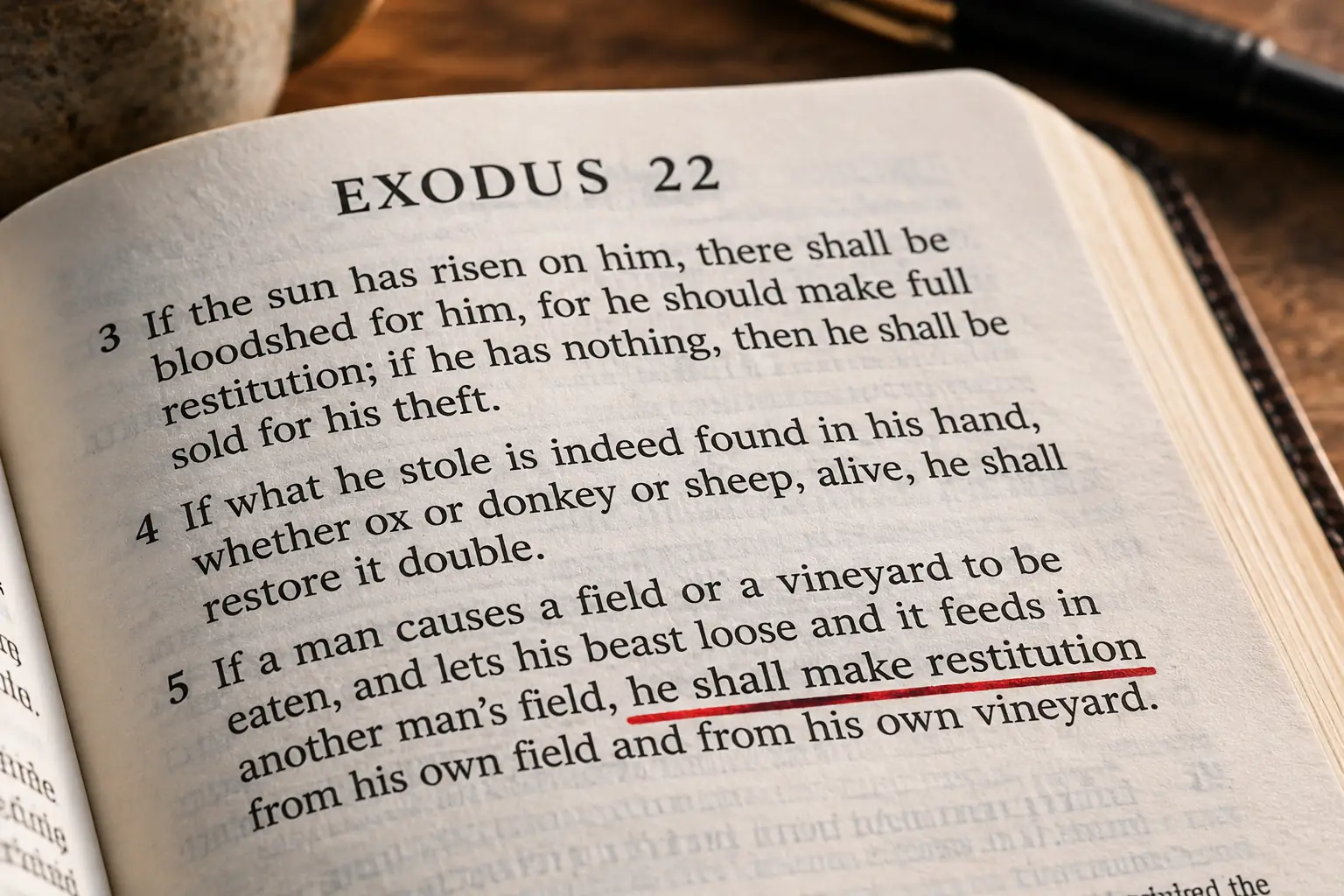
Throughout Exodus 21:33–22:15, God establishes obligations for those who steal, damage, or destroy another person’s property. Sometimes the offender must replace what was lost. In other cases, he must compensate the owner beyond the original value.
Consider Exodus 22:1:
“If a man steals an ox or a sheep, and slaughters it or sells it, he shall restore five oxen for an ox and four sheep for a sheep.”
Notice that God does not merely require the thief to acknowledge his wrongdoing or suffer punishment. He requires him to make restitution.
The Hebrew word frequently translated as restore, repay, or make restitution is שָׁלַם (shalam), which carries the idea of making good a loss, fulfilling an obligation, or paying what is owed. Interestingly, it belongs to the same Hebrew word family as shalom, meaning peace, wholeness, or well-being.
Although the words are not interchangeable, their relationship is instructive. When someone wrongs his neighbor, something has been disrupted. A loss has occurred, and an obligation exists that must be addressed.
This reveals something important about biblical justice: God is concerned not merely with punishing the offender, but also with restoring what the offended has lost.
Punishment may address the offender’s guilt, but it does not necessarily repair the damage. Restitution seeks to make good that loss.
And this principle extends beyond property. When we wrong someone, an apology may be appropriate, but it is not always sufficient. True repentance should include a willingness to make right what we have wronged, insofar as we are able.
But what happens when we consider our wrongdoing against God?
A Debt We Could Never Repay
The restitution laws teach us that wrongdoing creates an obligation. Yet Scripture reminds us that our greatest offense is against God Himself.
We have failed to render Him the obedience, worship, and honor He is due. And unlike the thief in Exodus, who might be able to repay what he has stolen, we cannot make satisfaction for our sins.
We cannot undo our disobedience. Nor can we compensate for yesterday’s sins with tomorrow’s obedience, because that obedience is already owed to God.
So what hope do we have?
The answer is Jesus Christ.
Christ came not merely to teach us how to live, but to accomplish what we could never accomplish ourselves. He rendered the perfect obedience we failed to render, bore the penalty our sins deserved, and satisfied divine justice.
The Westminster Shorter Catechism describes Christ’s priestly work as His “once offering up of himself a sacrifice to satisfy divine justice, and reconcile us to God” (Q. 25).
Notice those two realities: justice satisfied and reconciliation accomplished.
There is a particularly striking connection in Leviticus 5–6. When someone wrongfully took or withheld another person’s property, he was required to make restitution and bring a guilt offering before the Lord. His wrongdoing involved both an obligation toward his neighbor and guilt before God.
The Hebrew word for this guilt offering is asham (אָשָׁם).
Now consider Isaiah 53:10, where the suffering Servant makes His soul an “offering for sin.” The Hebrew word is the same: asham.
Here we see the wonderful fulfillment in Christ. The One who committed no wrong willingly offered Himself for those who could never make satisfaction for their sins.
As Isaiah declares:
“But He was wounded for our transgressions, He was bruised for our iniquities; the chastisement for our peace was upon Him, and by His stripes we are healed” (Isaiah 53:5).
We owed a debt we could never pay, yet Christ, who owed nothing, gave Himself to satisfy divine justice on our behalf.
And remarkably, He accomplishes even more.
More Than Restitution
Restitution seeks to make good what has been lost. But Christ does more than simply return His people to their former condition.
Consider Adam. Through his disobedience, sin and death entered the world, and humanity was plunged into guilt and misery.
But through Christ, the second Adam, sinners are justified, death is defeated, and the restoration of all things is assured.
Paul writes:
“For as by one man’s disobedience many were made sinners, so also by one Man’s obedience many will be made righteous” (Romans 5:19).
Christ does not merely return His people to Eden. He secures for them an everlasting inheritance in the new creation.
Where Adam brought condemnation, Christ brings justification. Where Adam brought death, Christ brings life.
The gospel is not merely about recovering what was lost, but about receiving something greater through the finished work of Jesus Christ.
Restitution as the Fruit of Repentance
One of the clearest demonstrations of this principle appears in the account of Zacchaeus.
When Zacchaeus encountered Christ, he declared:
“Look, Lord, I give half of my goods to the poor; and if I have taken anything from anyone by false accusation, I restore fourfold” (Luke 19:8).
Notice what happened. Zacchaeus did not merely acknowledge his wrongdoing. He committed himself to making restitution, echoing the principles found in Exodus 22.
But Zacchaeus was not purchasing salvation through restitution. Rather, his willingness to restore what he had taken demonstrated the transforming power of God’s grace.
The man who had previously enriched himself at the expense of others was now willing to give generously and make right what he had wronged.
This is precisely the transformation Paul describes in Ephesians 4:28:
“Let him who stole steal no longer, but rather let him labor, working with his hands what is good, that he may have something to give him who has need.”
The thief becomes a worker. The taker becomes a giver.
The gospel does not merely call us to abandon our former sins. It transforms us so that we begin practicing the righteousness that stands opposite those sins.
Living as Those Who Have Been Restored
So what does this mean for us?
First, we ought to take seriously the wrongs we have committed against others. If we have stolen, damaged, or wrongfully withheld what belongs to someone else, repentance should move us to make restitution wherever possible.
Second, we must remember that receiving forgiveness does not necessarily eliminate our obligations toward those we have wronged. We may be forgiven by God and still owe our neighbor compensation.
Finally, having received such extraordinary grace, we ought to become people who give rather than take. Our possessions are not merely ours to protect, but gifts from God to steward for the good of others.
The restitution laws remind us that God cares about justice, responsibility, and making right what has been wronged. But they also direct our attention toward something far greater.
We were guilty sinners, unable to make satisfaction for our offenses against God. Yet Jesus Christ, who had committed no wrong, gave Himself for us. He satisfied divine justice, reconciled us to the Father, and secured an inheritance that can never be lost.
Restitution teaches us that wrongs must be made right. The gospel declares that Christ has done for us what we could never do for ourselves.
And having received such grace, may we be quick to acknowledge our wrongs, eager to make restitution, and generous toward those whom God has placed in our lives.
HCC Blog: https://holycovenantchurch.com/blog/
Sermon Link: https://www.youtube.com/watch?v=8B-tXm81HQ8&t=6417s
Previous Post: https://holycovenantchurch.com/thou-shall-not-kill-when-death-becomes-medicine/