
Introduction
In our recent sermon on the Sixth Commandment, we considered God’s declaration: “You shall not murder” (Exodus 20:13). We saw that this commandment requires more than simply refraining from unlawfully taking another person’s life. It also requires us to preserve and protect human life and dignity, treating our neighbors as those created in God’s image.
Undergirding these obligations is a foundational biblical truth: human life belongs to God.
We are not the authors of our existence, nor are we its ultimate authorities. God gives life, sustains it, and determines its boundaries. As Job confessed, “The LORD gave, and the LORD has taken away; Blessed be the name of the LORD” (Job 1:21).
Yet this truth stands in sharp contrast to a culture that increasingly regards personal autonomy as the ultimate authority over human existence. If our bodies belong exclusively to us, the argument goes, then surely we should have the right to determine not only how we live, but when and how we die.
Few developments illustrate this shift more clearly than the growing acceptance of physician-assisted suicide, often described today as medical aid in dying or death with dignity.
What was once widely condemned as a violation of medical ethics is increasingly presented as an act of compassion, a legitimate medical option, and even an expression of human dignity.
How did we get here? What do these terms actually mean? And how should Christians respond?
To answer these questions, we must look beyond medical terminology and consider the more fundamental issues of life, suffering, death, and the authority of God.
What Are We Talking About?
Before considering how we arrived at this point, we need to understand the terminology. Words matter, particularly when they influence how we understand moral questions.
Physician-assisted suicide refers to a physician providing a patient with the means to intentionally end his or her own life, typically through prescribed medication that the patient administers. The American Medical Association (AMA) defines the practice in terms of a physician supplying the means or information necessary for a patient to perform the life-ending act.[1]
Medical aid in dying (MAID) is a term used in the United States for legally authorized medical assistance in ending one’s life. Under laws such as Oregon’s Death with Dignity Act, eligible patients may obtain prescribed medication that they administer themselves.[2] In Canada, the related term medical assistance in dying includes both self-administration and direct administration by an authorized medical professional.[3]
Euthanasia refers to intentionally ending another person’s life, ordinarily for the stated purpose of relieving suffering. It differs from assisted suicide principally in who performs the act that causes death. The AMA addresses euthanasia separately from physician-assisted suicide in its Code of Medical Ethics.[4]
Palliative care, by contrast, seeks to relieve pain and other symptoms of serious illness while improving quality of life. It may include medical treatment, emotional support, and spiritual care, and it can be provided alongside treatment intended to cure an illness.[5]
Hospice care focuses on comfort and support for patients approaching the end of life, rather than pursuing curative treatment. It is a particular form of palliative care that also provides support for patients’ families.[5]
These distinctions are important because there is a meaningful difference between allowing someone to die naturally and intentionally causing that person’s death.
Christians are not obligated to pursue every possible medical intervention to prolong life. Refusing treatment that is ineffective or excessively burdensome is not necessarily equivalent to suicide. Nor is providing appropriate medication to relieve severe pain, even when such treatment carries foreseeable risks, necessarily equivalent to intentionally ending life.
The moral question concerns not merely whether death follows a medical decision, but what is being intended and accomplished by that decision.
How Did We Get Here? From Murder Conviction to Medical Treatment
For many Americans, the modern debate over physician-assisted suicide is inseparably connected to the name Jack Kevorkian.
Throughout the 1990s, Kevorkian, widely known as “Dr. Death,” openly advocated for the right of seriously ill individuals to end their lives with medical assistance. He claimed to have helped more than 130 people die, arguing that assisting suffering patients in ending their lives was an act of compassion rather than a violation of medical ethics.
But his activities were not simply controversial. They resulted in criminal prosecution.
In 1999, Kevorkian was convicted of second-degree murder after personally administering a lethal injection to Thomas Youk, a 52-year-old man suffering from amyotrophic lateral sclerosis (ALS). Kevorkian videotaped the procedure, portions of which were subsequently broadcast on 60 Minutes. He was sentenced to 10–25 years in prison and served approximately eight years before his release in 2007.[6]
Consider that for a moment. A physician who intentionally ended the life of a suffering patient was convicted of murder.
Now consider how dramatically the conversation has changed.
What was once associated with criminal prosecution, medical controversy, and the notorious nickname “Dr. Death” is increasingly discussed in the language of compassion, dignity, personal autonomy, and medical care.
The terminology itself reflects this transformation. Rather than speaking of assisted suicide, advocates increasingly use expressions such as medical aid in dying. The emphasis shifts from the intentional ending of human life to the relief of suffering and the preservation of personal dignity.
This shift is particularly striking when considered against the historical traditions of medical ethics.
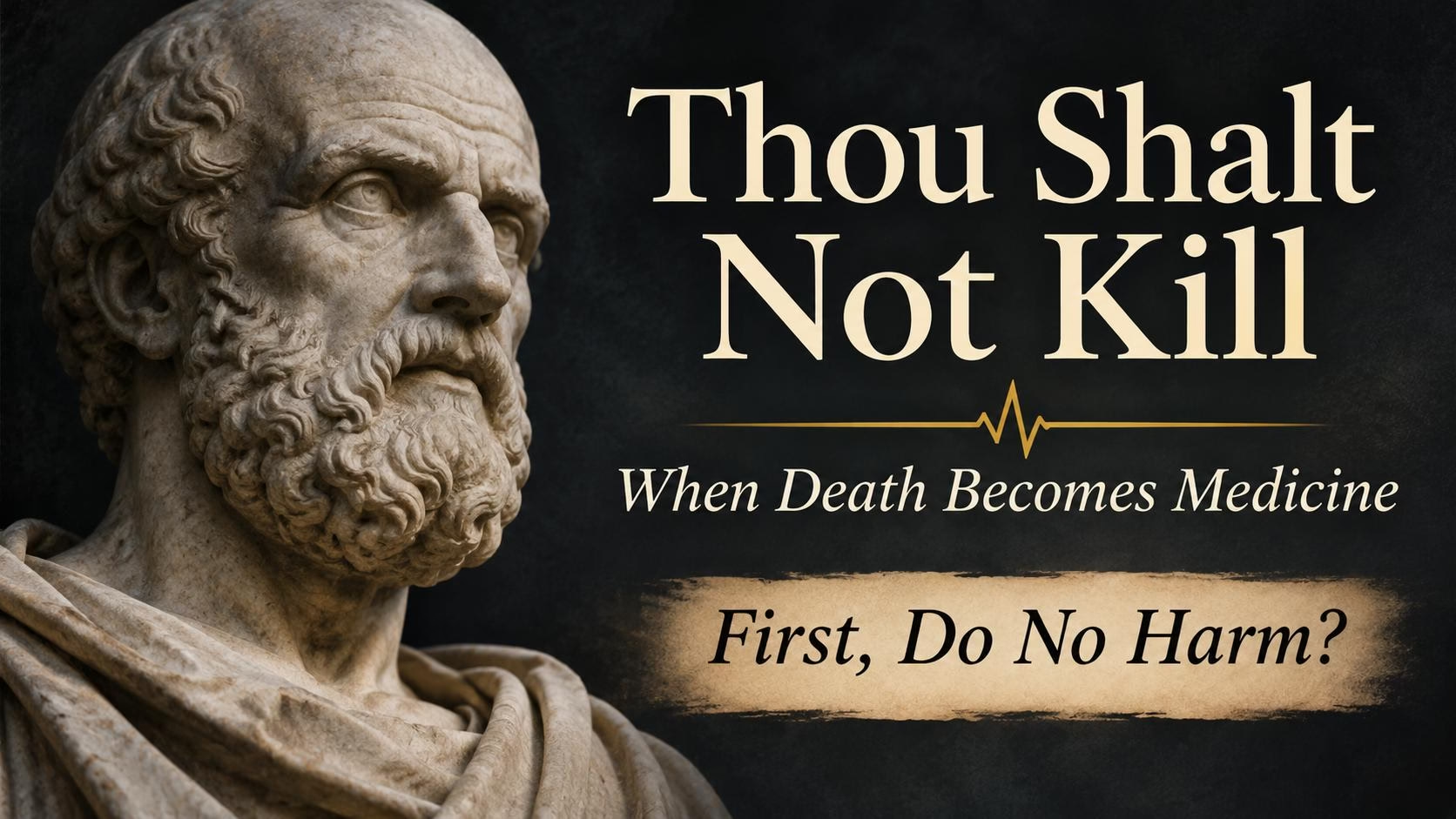
For centuries, physicians have looked to the Hippocratic Oath as an expression of their professional responsibilities. Although its precise language and contemporary application have varied, the classical oath included a prohibition against providing a deadly drug, even when requested.[7]
The familiar medical maxim “First, do no harm,” though not a direct quotation from the classical oath, captures an important aspect of this tradition: the physician’s responsibility to care for the patient rather than intentionally bring about his death.
But perhaps even more striking is that this concern has not disappeared from modern medicine.
The American Medical Association’s Code of Medical Ethics, Opinion 5.7, states:
“Physician-assisted suicide is fundamentally incompatible with the physician’s role as healer”
— American Medical Association, Code of Medical Ethics, Opinion 5.7, “Physician-Assisted Suicide.”[1]
The AMA further warns of serious societal risks and emphasizes that physicians must respond to suffering patients with appropriate pain relief, emotional support, and continued care.
This is an important distinction. Although assisted suicide has gained legal and cultural acceptance in various jurisdictions, it has not achieved universal acceptance within the medical profession itself. The AMA’s position demonstrates that ethical objections are not merely religious objections imposed upon medicine from the outside.
The question of whether physicians should intentionally participate in ending human life remains a matter of serious disagreement within medicine.
Meanwhile, the legal landscape has changed considerably. Oregon’s Death with Dignity Act, which took effect in 1997, established a legal framework for physician-assisted dying. Washington followed in 2009, and other jurisdictions have since adopted similar measures. Canada permits medical professionals, under specified circumstances, to administer medications that intentionally cause death.[2][3][8]
Important legal distinctions exist between Kevorkian’s actions and contemporary assisted-dying laws. In many American jurisdictions, physicians prescribe medication that patients must administer themselves, whereas Kevorkian’s murder conviction involved his personally administering a lethal injection.
Nevertheless, the underlying moral question remains: Under what circumstances, if any, does human suffering justify intentionally bringing about the end of human life?
And once death is accepted as a legitimate response to suffering, additional questions follow. Must the patient be terminally ill? What about chronic but nonterminal conditions? What about severe psychological suffering? Who determines when suffering has become intolerable?
These are not merely hypothetical questions. They have become matters of public policy and ethical debate in jurisdictions where assisted dying has been legalized.
The progression is striking. Within a few decades, we have moved from watching a physician convicted of murder for intentionally ending a patient’s life to governments establishing legal procedures through which physicians may participate in bringing about a patient’s death.
And increasingly, these practices are defended not as unfortunate exceptions to the duty to preserve life, but as expressions of compassion, autonomy, and human dignity.
So what has changed? What has happened in our understanding of life, suffering, dignity, and death that has brought us from the days of Jack Kevorkian’s murder conviction to the growing acceptance of medically assisted death today?
How Should Christians Respond?
The answer, I would suggest, is not that we have discovered something fundamentally new about human life or suffering. Rather, our culture has increasingly embraced a different understanding of what makes life valuable and who possesses authority over it.
Where Scripture grounds human dignity in our creation in God’s image, modern arguments for assisted dying frequently emphasize autonomy, personal choice, and the ability to control one’s circumstances.
This does not mean that those who advocate assisted dying are indifferent to suffering. Many sincerely believe they are acting compassionately. But compassion, however sincere, must be governed by truth.
For Christians, the proper response begins by returning to the biblical principles that our culture has increasingly set aside.
1. Life Belongs to God
The Christian response must begin with God’s authority over human life.
Genesis 1:26–27 teaches that mankind was created in the image of God. Our dignity is therefore not something we acquire through intelligence, independence, productivity, physical ability, or freedom from suffering. It is something God has bestowed upon us.
Genesis 9:6 makes the connection even more explicit. The prohibition against unlawfully taking human life is grounded in the fact that mankind bears God’s image.
This means sickness does not diminish our humanity. Disability does not erase our dignity. Dependence upon others does not make us less valuable.
The elderly man confined to his bed, the woman suffering from a debilitating illness, and the child requiring lifelong assistance all possess the dignity of those made in God’s image.
Our obligation, therefore, is not to determine when another person’s life has ceased to be worth living, but to honor and protect that life because it belongs to God.
2. Suffering Is Not Meaningless
One of the central arguments for assisted suicide is that individuals should not be required to endure suffering they consider intolerable.
Christians should never minimize such suffering. Pain can be agonizing. Disease can rob individuals of abilities they once enjoyed. The prospect of prolonged decline can produce profound fear, loneliness, and anguish.
But Scripture teaches something our culture often struggles to understand: suffering does not render life meaningless.
Romans 5:3–5 teaches that tribulation produces perseverance, character, and hope. James 1:2–4 reminds believers that trials can serve God’s sanctifying purposes. And in 2 Corinthians 4:16–18, Paul directs our attention beyond present afflictions to the eternal glory awaiting God’s people.
None of this means suffering is pleasant, that we should seek it, or that we should refuse appropriate measures to alleviate it. Nor does it mean we can identify God’s particular purpose in every instance of suffering.
Rather, it means that God can accomplish purposes through suffering that we may not presently understand.
Indeed, the clearest demonstration of this truth is found in Jesus Christ. Through the greatest injustice and suffering in human history, God accomplished the redemption of His people.
The Christian hope is not that suffering itself is good, but that our good and sovereign God is able to work through it.
And if God could bring life through the suffering and death of His Son, we should be exceedingly cautious about declaring that a suffering life can no longer have purpose.
3. Death Is Not the Ultimate Solution
Another assumption underlying assisted suicide is that death provides a final escape from suffering.
From a materialistic perspective, this may seem reasonable. If suffering is merely a function of bodily existence, then ending bodily existence appears to end the problem.
But Christianity rejects the assumption that death is the end of human existence.
Scripture declares, “It is appointed for men to die once, but after this the judgment” (Hebrews 9:27).
Death does not eliminate our accountability before God, nor does it automatically usher everyone into peace.
For those who belong to Christ, death is indeed gain (Philippians 1:21), not because death is inherently good, but because Christ has conquered it. For those outside of Christ, death offers no assurance of relief from suffering.
Our ultimate hope is not escape from bodily existence, but the resurrection of the body and the restoration of all things through Jesus Christ.
4. These Are Metaphysical Questions, Not Merely Medical Ones
Here we arrive at what may be the most fundamental issue in the entire debate.
Physician-assisted suicide is commonly discussed as a medical matter. Physicians assess the patient’s condition, determine eligibility, explain available treatments, and, where legally permitted, provide the means of death.
But the questions at the heart of this debate are not ultimately medical. They are metaphysical and moral.
Medicine can tell us whether a patient is dying, but it cannot tell us whether that patient’s life is worth living. It can describe the nature of suffering, but it cannot determine whether suffering has meaning. It can explain what is medically possible, but it cannot, by itself, establish what is morally permissible.
Those questions concern the nature of human existence, the source of human dignity, the purpose of suffering, and the authority we possess over life and death.
When we treat assisted suicide as merely another medical procedure, we risk allowing medicine to make judgments that belong to a much broader moral and theological framework.
The question is not simply whether physicians possess the ability to end human life. Clearly, they do.
The question is whether they, or anyone else, possess the moral authority to do so.
If life is merely the possession of the individual, then personal autonomy may appear sufficient to justify its termination. But if life is a gift entrusted to us by our Creator, then our authority over it is necessarily limited by His will.
The assisted-suicide debate is therefore not simply a disagreement about medical treatment. It reflects fundamentally different understandings of what it means to be human.
5. Compassion Requires More Than Opposition
Finally, Christians must do more than simply oppose assisted suicide. We must demonstrate what it means to preserve and protect human life.
It is relatively easy to affirm the sanctity of life in principle. It is considerably more demanding to sit beside someone who is dying, care for someone who can no longer care for himself, or patiently minister to someone whose suffering has become overwhelming.
Yet this is precisely the kind of love the Sixth Commandment requires.
We should support appropriate medical treatment, palliative care, and hospice services that seek to relieve suffering without intentionally causing death. We should encourage families caring for elderly or disabled loved ones, provide practical assistance where possible, and refuse to treat dependence as a loss of human dignity.
We should also listen carefully to those who express a desire to die. Such expressions may arise from physical pain, but they may also reflect fear, loneliness, depression, or a sense of being burdensome to others. These concerns deserve serious attention, compassionate presence, and appropriate professional care.
Christians should be among the first to remind suffering individuals that their lives remain valuable, that they have not ceased to bear God’s image, and that they are not abandoned in their weakness.
In this way, we demonstrate that our commitment to preserving life is not merely a position on a controversial issue. It is an expression of our love for God and neighbor.
Conclusion: Compassion Governed by Truth
The growing acceptance of assisted suicide reveals a fundamental disagreement about the nature and value of human life. Is dignity grounded in our ability to control our circumstances, or in the God whose image we bear? Does suffering make life less worthy of preservation, or does our obligation to love our neighbor remain even in the most difficult circumstances?
Scripture answers these questions by reminding us that life belongs to God. Suffering does not erase human dignity, and death is not humanity’s ultimate solution. Christ, who suffered, died, and rose again, is our hope in both life and death.
But these convictions must do more than shape our arguments. They must shape our actions.
If we believe that human life belongs to God, then we must be willing to care for those whose lives are marked by suffering. We must visit the sick, comfort the dying, support exhausted caregivers, and remind those who feel forgotten or burdensome that their lives possess dignity that neither illness nor dependence can take away.
The Sixth Commandment does not merely tell us whose lives we must not take. It teaches us whose lives we must love and protect.
May we therefore be a people who not only defend the dignity of human life with our words, but demonstrate it through our love for those who suffer.
Sources and References
- American Medical Association, Code of Medical Ethics, Opinion 5.7, “Physician-Assisted Suicide.” https://code-medical-ethics.ama-assn.org/ethics-opinions/physician-assisted-suicide
- Oregon Health Authority, “Death with Dignity Act: Frequently Asked Questions.” https://www.oregon.gov/oha/ph/providerpartnerresources/evaluationresearch/deathwithdignityact/pages/faqs.aspx
- Health Canada, “Medical Assistance in Dying.” https://www.canada.ca/en/health-canada/services/medical-assistance-dying.html
- American Medical Association, Code of Medical Ethics, Opinion 5.8, “Euthanasia.” https://code-medical-ethics.ama-assn.org/ethics-opinions/euthanasia
- National Institute on Aging, “What Are Palliative Care and Hospice Care?” https://www.nia.nih.gov/health/hospice-and-palliative-care/what-are-palliative-care-and-hospice-care/
- People of the State of Michigan v. Jack Kevorkian, Michigan Court of Appeals, November 20, 2001. https://law.justia.com/cases/michigan/court-of-appeals-published/2001/20011120-c221758-75-213o-221758-opn-coa.html
- National Institutes of Health, Oath of Hippocrates, historical translation. https://history.nih.gov/download/attachments/1016866/hippocratic.pdf
- Washington State Department of Health, “Death with Dignity Act.” https://doh.wa.gov/data-and-statistical-reports/health-statistics/death-dignity-act
HCC Blog: https://holycovenantchurch.com/blog/
Sermon Link: https://www.youtube.com/watch?v=GUjA6JllYz0&t=6800s
Previous Blog Post: https://holycovenantchurch.com/slavery-and-scripture-a-closer-look/