
Introduction
This past Lord’s Day, we considered the three parables Jesus tells in Matthew 24:45–25:30: the faithful and wicked servants, the ten virgins, and the talents. Together, they teach us how the subjects of Christ’s kingdom are to live while awaiting the return of the King. We are to be expectant, equipped, and engaged.
But these parables do not appear out of nowhere. They fall directly on the heels of the Olivet Discourse, one of the most debated passages in the New Testament. And understanding what comes before the parables helps us better understand why Jesus tells them.
Fair warning, this post is a little longer than my usual post, nevertheless, enjoy.
Two Questions
The discourse begins when Jesus tells His disciples that the magnificent temple they are admiring will be completely destroyed:
“Not one stone shall be left here upon another, that shall not be thrown down” (Matthew 24:2).
The disciples naturally want to know more:
“Tell us, when will these things be? And what will be the sign of Your coming, and of the end of the age?” (Matthew 24:3).
The disciples appear to join these events together. If the temple is going to be destroyed, surely this must mean the end has arrived. But in His answer, Jesus distinguishes between an approaching judgment they would be able to recognize and a future day whose timing they could not know.
Christians have interpreted His answer in several different ways.
Dispensationalists generally understand most of Matthew 24 as describing a future Great Tribulation immediately preceding Christ’s return.
Full preterists go in the opposite direction, seeing essentially the entire discourse—including Christ’s coming—as fulfilled in the events surrounding AD 70. In doing so, full preterism ultimately leaves no future bodily return of Christ and therefore departs from the historic Christian confession.
Partial preterism offers a better way. It understands Matthew 24:4–35 primarily as describing the coming judgment upon Jerusalem, while verse 36 begins a transition to Christ’s future return.
“These Things” and “This Generation”
One of the strongest reasons for this interpretation is Jesus’ own time marker:
“Assuredly, I say to you, this generation will by no means pass away till all these things take place” (Matthew 24:34).
We should allow “this generation” to mean what it naturally appears to mean—the generation to whom Jesus was speaking.
The context strengthens this conclusion. Just a few verses earlier, Jesus had condemned the scribes and Pharisees and declared:
“Assuredly, I say to you, all these things will come upon this generation” (Matthew 23:36).
He then lamented over Jerusalem, declared its house desolate, left the temple, and predicted its destruction.
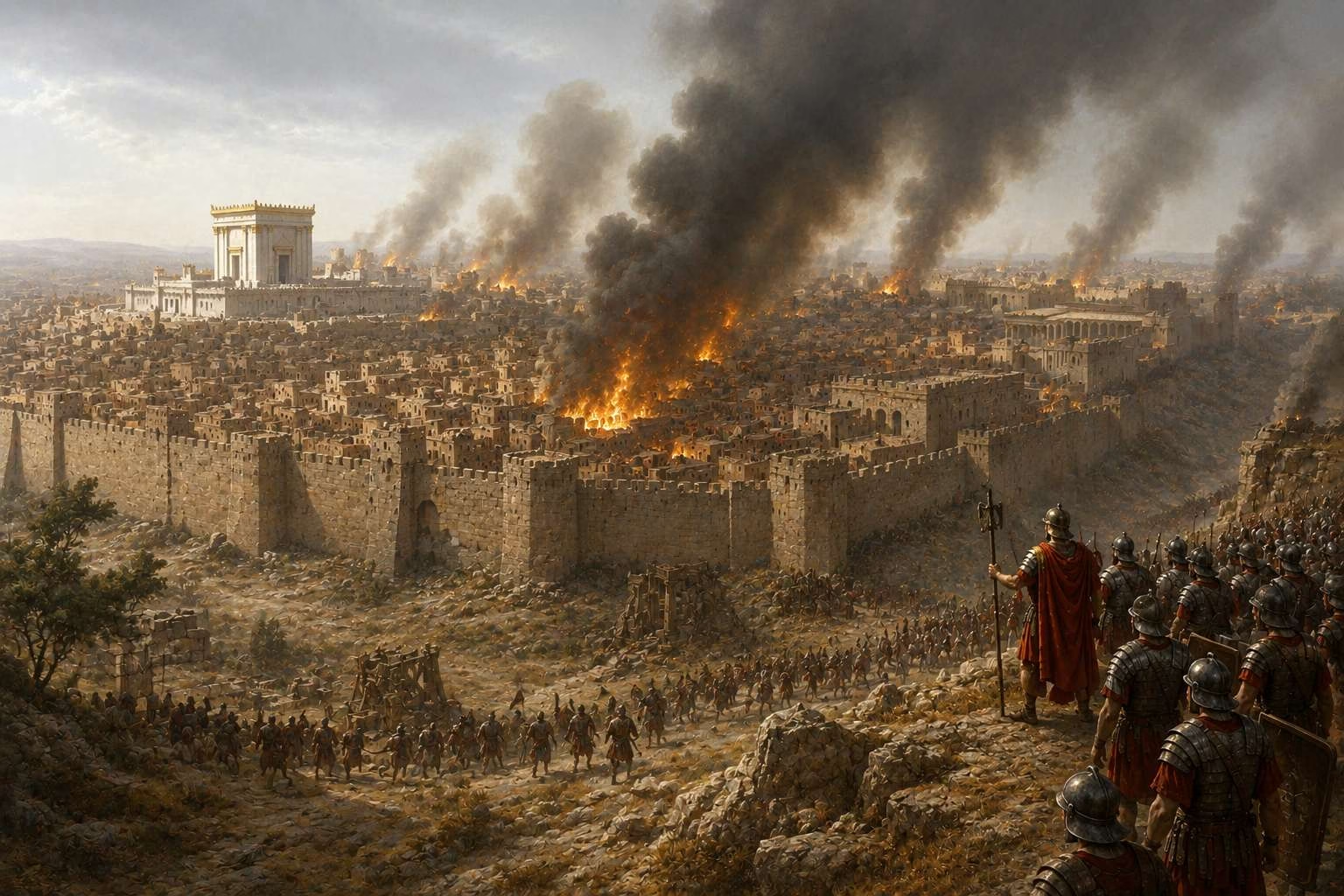
Within roughly forty years, Jerusalem was surrounded by Roman armies. In AD 70, the city and temple were destroyed.
Jesus’ words came to pass just as He said.
A Judgment They Could See Coming
There is another important clue.
Before verse 36, Jesus repeatedly tells His disciples to watch for identifiable events:
“When you see all these things, know that it is near—at the doors!” (Matthew 24:33).
Luke’s parallel makes the historical reference even clearer:
“When you see Jerusalem surrounded by armies, then know that its desolation is near” (Luke 21:20).
When they saw these things, they were to flee Judea.
This judgment, therefore, was something Jesus’ disciples could see approaching. There were signs. They could recognize them and act accordingly.
That makes what Jesus says next particularly significant.
“But of That Day”
Verse 36 introduces an important change:
“But of that day and hour no one knows…”
Notice the contrast.
Before verse 36: When you see these things, know that it is near.
Beginning in verse 36: Of that day and hour no one knows.
Jesus moves from “these things”, which would occur within “this generation,” to “that day,” whose timing remains unknown.
This is where the partial-preterist interpretation makes particularly good sense of the passage. Jesus has described the approaching destruction of Jerusalem. Now He turns His disciples’ attention toward His final return.
What About the Cosmic Language?
One reason many Christians hesitate to understand Matthew 24:4–35 as fulfilled in the first century is the dramatic language of verses 29–30:
“The sun will be darkened, and the moon will not give its light; the stars will fall from heaven…”
To us, that immediately sounds like the end of the physical universe. But Jesus is speaking the language of the Old Testament prophets.
Isaiah described God’s judgment upon Babylon in similar terms:
“The stars of heaven and their constellations will not give their light; the sun will be darkened…” (Isaiah 13:10).
Isaiah also described judgment upon Egypt by saying:
“Behold, the LORD rides on a swift cloud, and will come into Egypt” (Isaiah 19:1).
The prophets regularly used cosmic language to describe God shaking kingdoms, overthrowing rulers, and bringing covenantal judgment.
Likewise, Jesus’ reference to the Son of Man “coming on the clouds” draws upon Daniel 7, where the Son of Man comes to the Ancient of Days and receives dominion, glory, and a kingdom.
The destruction of Jerusalem was therefore not Christ’s final bodily return. It was a dramatic historical demonstration that the rejected and crucified Messiah had been enthroned as King.
And Then Come the Parables
This brings us back to the three parables we considered this past Lord’s Day.
Once Jesus says that no one knows the day or hour of His return, He immediately begins teaching His disciples how they should live in light of that uncertainty.
And notice the repeated emphasis upon delay.
The wicked servant says:
“My master is delaying his coming” (Matthew 24:48).
With the ten virgins:
“The bridegroom was delayed” (Matthew 25:5).
And in the parable of the talents:
“After a long time the lord of those servants came and settled accounts with them” (Matthew 25:19).
That progression is important.
Jesus does not tell His disciples when He will return. Instead, He prepares them for the possibility that His return may be “after a long time.”
Therefore, His church must know how to live while the King is away.
Faithfulness Rather Than Speculation
This is where eschatology becomes intensely practical.
Jesus does not want His church spending every generation trying to determine whether the latest war, earthquake, election, technological development, or conflict in the Middle East finally proves that His return must happen within the next few years.
Much of what Christians have been taught to regard as signs of the end belonged to the judgment Jesus said would fall upon that generation.
As for His final return, Jesus says we do not know.
And that is precisely why we must be ready.
The servant is not praised because he correctly predicts when his master will return. He is praised because he is faithfully serving when his master returns.
The wise virgins do not know when the bridegroom will arrive. They are prepared when he does.
The servants entrusted with talents do not know how long their master will be gone. They are busy with their master’s business when he returns.
Christian readiness is not primarily about prediction. It is about faithfulness. May we, as subjects of the King be about our his business as we await.
HCC Blog: https://holycovenantchurch.com/blog/
Sermon Link: https://www.youtube.com/watch?v=NSE03fOUPCw
Previous Blog: https://holycovenantchurch.com/mercy-that-crosses-borders/