
Introduction
In our recent sermon, Covenant Worship, from Exodus 20:22–26, we considered Yahweh’s instructions concerning the construction of an altar. The altar was central to Israel’s worship, for it was there that burnt offerings expressed consecration to God and peace offerings celebrated fellowship with Him. Thus, Yahweh was doing more than regulating the construction of a religious structure; He was directing how His people were to approach and worship Him.
At first glance, His instructions seem unnecessarily restrictive. The Israelites were to construct an altar of earth or uncut stones, without the embellishments of human craftsmanship. Indeed, Yahweh forbade the use of tools upon the stones, declaring that doing so would profane the altar (Exodus 20:25). Why such concern over something so ordinary? Because even here, God was teaching His people that worship was not to be shaped by their ingenuity or preferences. God Himself determines how He is to be worshiped.
This principle, which we briefly considered in the sermon, is historically called the Regulative Principle of Worship in Reformed theology. But what does it mean, and what does it not mean?
What Is the Regulative Principle of Worship?
The Westminster Confession of Faith summarizes the principle in chapter 21, paragraph 1:
“But the acceptable way of worshipping the true God is instituted by himself, and so limited by his own revealed will, that he may not be worshipped according to the imaginations and devices of men, or the suggestions of Satan, under any visible representation, or any other way not prescribed in the Holy Scripture.”
Simply put, acceptable worship is instituted by God Himself. We do not invent ways to worship Him and then hope for His approval. Rather, He graciously reveals how we are to approach Him.
To illustrate this in the sermon, I used the example of a husband whose wife has repeatedly expressed her desire for flowers or a nice dinner together. Yet, disregarding her wishes, he comes home with a brand-new 75-inch television and a shiny new grill, announcing, “Honey, look what I bought you because I love you!” We all know how that conversation is likely to end!
The point is simple: Love seeks to please the one who is loved, not merely the one doing the loving. How much more should this be true of our worship? As Jesus declares, “If you love Me, keep My commandments” (John 14:15, NKJV).
An important distinction follows. The Regulative Principle does not merely ask whether a worship practice is forbidden by Scripture, but whether it is warranted by Scripture. This differs from the Normative Principle of Worship, which generally permits practices Scripture does not forbid, provided they are consistent with biblical teaching. One asks, “Has God authorized this?” while the other asks, “Has God forbidden this?”
John Calvin recognized this distinction in The Necessity of Reforming the Church (1543), observing, “I know how difficult it is to persuade the world that God disapproves of all modes of worship not expressly sanctioned by his word.”
Consider again the altar in Exodus 20. An Israelite might have reasoned that beautiful craftsmanship would honor Yahweh. Yet God had specifically forbidden the use of tools upon its stones. What mattered was not what seemed fitting to the worshiper, but what God had appointed.
For the church today, this means that our corporate worship should consist of the elements God has authorized, including the reading and preaching of Scripture, prayer, singing praises, and the administration of baptism and the Lord’s Supper. These are not merely traditions but divinely appointed practices. While Scripture leaves room for prudence concerning circumstances such as the time of gathering or the number of songs, the elements themselves require biblical warrant (WCF 1.6).
Put simply, the church has freedom in arranging its worship, but not in inventing it.
Nadab and Abihu: When Good Intentions Are Not Enough
One of the clearest and most sobering illustrations of this principle appears in Leviticus 10:1–3, shortly after the events at Sinai.
Nadab and Abihu, the sons of Aaron, were priests appointed to serve Yahweh. Yet they offered “profane fire before the LORD, which He had not commanded them” (Leviticus 10:1, NKJV). The consequences were immediate: fire went out from the LORD and consumed them.
Notice the connection to Exodus 20. There, Yahweh prescribed the altar and sacrifices; here, He had prescribed the priestly service. In both cases, those approaching God were not free to determine how He should be worshiped.
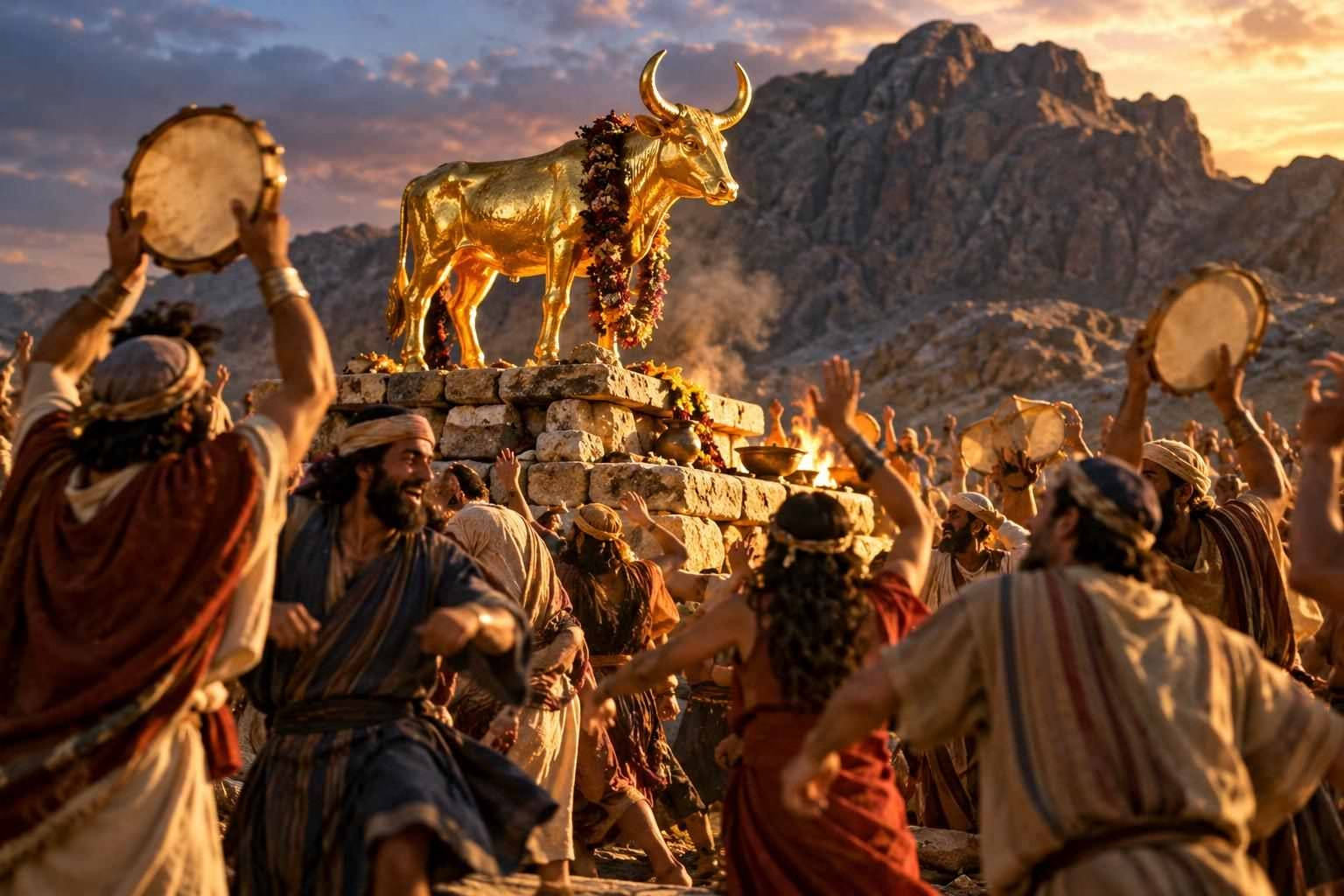
Nor was this an isolated occasion. Israel fashioned a golden calf through which to worship Yahweh and incurred His judgment (Exodus 32:4–6, 25–28). Korah’s company presumed to offer incense without divine authorization and was consumed by fire (Numbers 16:35, 40). King Uzziah likewise presumed to offer incense, a duty reserved for the priests, and was struck with leprosy (2 Chronicles 26:16–21).
Though the circumstances differed, the principle remained the same: God alone determines how He is to be worshiped. Sincerity, religious enthusiasm, or good intentions cannot make acceptable what God has not authorized.
Following the judgment of Nadab and Abihu, Moses reminds Aaron of Yahweh’s words:
“By those who come near Me I must be regarded as holy; And before all the people I must be glorified.” (Leviticus 10:3, NKJV)
The lesson is sobering. Worship must honor God’s holiness according to His revealed will.
What the Regulative Principle Does Not Mean
The Regulative Principle is sometimes misunderstood or applied beyond what Scripture requires. Three clarifications are helpful.
First, it does not mean every detail of worship must be explicitly prescribed.
The Westminster Confession recognizes that certain circumstances of worship are governed by Christian prudence and the general rules of Scripture (WCF 1.6). Scripture commands the church to gather, but does not prescribe whether the service begins at 9:00 or 10:00. It commands singing, but does not specify the number of songs or particular tunes.
Even in Exodus 20, Yahweh regulated the materials and construction of the altar without specifying every practical detail. The principle does not eliminate human judgment; it requires that judgment to remain subordinate to Scripture.
Second, it does not mean worship must be lifeless, joyless, or devoid of beauty.
Scripture repeatedly commands God’s people to rejoice, sing, and give thanks. Consider the peace offerings of Exodus 20:24. These were occasions of fellowship and thanksgiving, celebrating communion with God and one another.
The question is not whether worship should be joyful or beautiful, but whether our understanding of these things is shaped by Scripture rather than merely by cultural preferences.
Third, it does not mean every disagreement about worship is a rejection of the principle.
The Regulative Principle specifically concerns worship and should not be confused with the broader Christian freedom to make lawful decisions in ordinary life. Furthermore, Christians may disagree about what constitutes an element of worship, a circumstance, or a legitimate expression of something God has commanded.
Although the principle has historically distinguished Reformed worship from Lutheran and Anglican approaches, disagreements remain within the Reformed tradition itself. Theologians such as John Frame affirm the Regulative Principle while arguing for a broader understanding of what Scripture authorizes.
Thus, the debate concerns not only whether worship requires biblical warrant, but what constitutes sufficient warrant. Such disagreements should drive us back to Scripture rather than lead us to assume that everyone who differs from our application has abandoned the principle.
Why This Matters for the Church Today
We live in a time when decisions about worship are frequently driven by personal preference, cultural relevance, entertainment, or what might attract the largest crowd.
Certainly, there is nothing inherently wrong with welcoming visitors or communicating clearly. But these considerations must never become the governing authority for worship. The fundamental question is not, What will people enjoy? or What will attract the largest crowd? Rather, it must be, What has God commanded, and how can we faithfully obey Him?
And here we return to something particularly encouraging in Exodus 20. After instructing Israel concerning the altar and sacrifices, Yahweh declares:
“In every place where I record My name I will come to you, and I will bless you.” (Exodus 20:24, NKJV)
Notice the promise. God does not merely prescribe how His people are to worship; He promises His presence and blessing. His instructions were not arbitrary restrictions but gracious provisions through which His people could enjoy fellowship with Him.
This is why the Regulative Principle is not merely a principle of restriction. It is also a gracious provision.
Under the old covenant, God appointed sacrifices, priests, and altars through which His people could approach Him. These institutions pointed forward to Jesus Christ, our great High Priest, whose once-for-all sacrifice has opened the way into God’s presence (Hebrews 10:19–22).
We do not approach God on the basis of our creativity, sincerity, or even the perfection of our obedience. We approach Him through Christ, whose sacrifice alone makes sinners acceptable before a holy God. And just as Yahweh promised His presence to Israel, Christ promises to be present with His gathered people (Matthew 18:20).
Our confidence in worship, therefore, rests not in how impressive our services may be, but in God’s gracious promises and the finished work of Jesus Christ.
A Final Encouragement
The altar of Exodus 20 was deliberately simple, but the promise attached to it was extraordinary: God would come to His people and bless them. The glory of their worship was not found in what their hands could construct, but in the God who graciously met them there.
Beloved, let us resist measuring worship primarily by how it makes us feel, how impressive it appears, or how attractive it may be to the world. Instead, let us delight in worshiping God according to His Word, confident that through Jesus Christ we have been welcomed into His presence.
altar in Exodus 20. An Israelite might have reasoned that beautiful craftsmanship would honor Yahweh. Yet God had specifically forbidden the use of tools upon its stones. What mattered was not what seemed fitting to the worshiper, but what God had appointed.
For the church today, this means that our corporate worship should consist of the elements God has authorized, including the reading and preaching of Scripture, prayer, singing praises, and the administration of baptism and the Lord’s Supper. These are not merely traditions but divinely appointed practices. While Scripture leaves room for prudence concerning circumstances such as the time of gathering or the number of songs, the elements themselves require biblical warrant (WCF 1.6).
Put simply, the church has freedom in arranging its worship, but not in inventing it.
HCC Blog: https://holycovenantchurch.com/blog/
Sermon Link: https://www.youtube.com/watch?v=9y1bPV-i4aI
Previous Blog Post: https://holycovenantchurch.com/covenant-of-the-great-yahweh/